



By F. Amanda Tugade, Des Moines Register
On a Wednesday afternoon in December, Arina Soda and her husband, Julio Moreno, greeted a family heading for the shelves that took over the entrance of their Des Moines hair salon and tattoo shop.
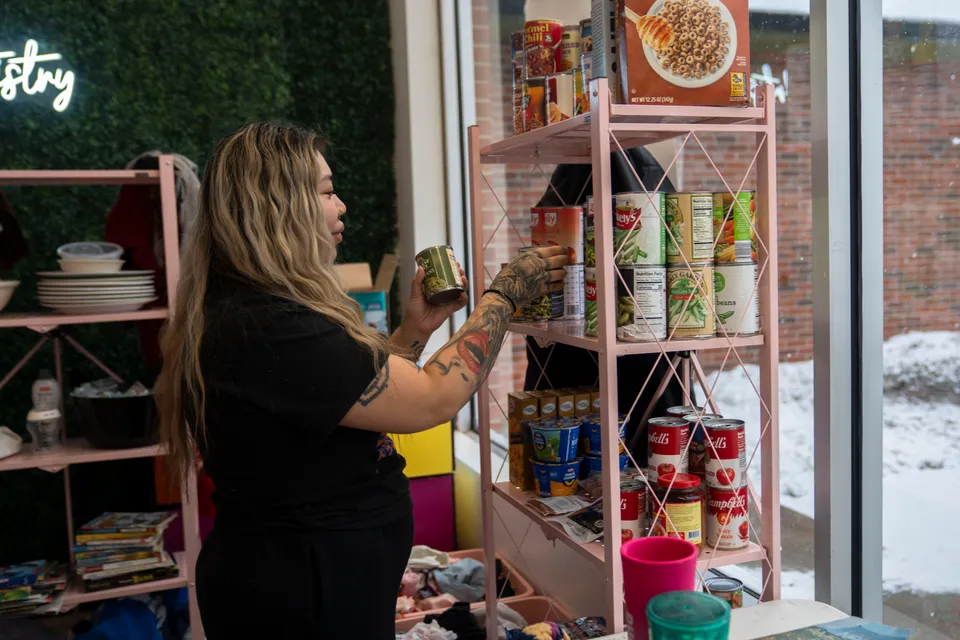
Soda said they could grab any of the items — canned goods, toiletries, diapers, shoes and children’s toys — on the shelves, tables or bins below. Moreno offered plastic bags for their belongings.
The couple, who opened Collective Artistry 515 at 5408 Douglas Ave. last summer, launched the inaugural pantry a week before Thanksgiving. As parents and small business owners, they understood the financial setbacks families were facing as the holidays drew near. News of cuts to SNAP benefits that same month only amplified a call to action. A social media post and support from another business led to more donations that continued to grow and took over a corner spot Soda previously used to shoot video content for social media.
“Available to anyone while the shop is open,” Soda, 28, wrote on an Instagram post. “Just pop in and take what you need, leave what you want.”
Lily Smith/The Register
Collective Artistry’s pantry is an example of the community-driven spaces Des Moines business owners have launched in the last year to unite Iowans and help others meet more than their basic needs. Soda and Moreno are among the city’s millennial entrepreneurs shaping their shops into third places to provide residents social lifelines — mainly a place they can belong. Third places like Collective’s pantry, DSM Flea’s Club Cafe, Vinyl Cup’s vinyl listening room and Glitter Factory DSM’s crafting classes are informal public gathering spaces where people are welcome to interact with others or spend alone time in the company of strangers.

Local business owners say their customers are hunting for hangout spots where they can stay for a few hours, meet new people or pick up a skill or hobby. They said they are expanding their efforts to make these third places more permanent and give people something money can’t buy — togetherness.
“Really, it’s all about sharing,” Soda said.

What is a third place?
Third places are all around. They include bars, coffee shops, churches, food pantries, libraries and parks. As well as Soda’s salon on the top floor of a former Sherwin-Williams paint store and Moreno’s tattoo shop beneath.
These places are not flashy but are key to people’s quality of life, said Jennifer Drinkwater, an art and visual culture professor at Iowa State University. She has studied third places’ impact on people’s mental health and well-being. People’s overall health benefit from social interactions — even small talk with a barista or a neighbor, she said.
“Those relationships matter just as much as, like, your family and friendships,” Drinkwater said. “Those are just as buffering against loneliness because there’s not that emotional heaviness in a lot of ways. It doesn’t require as much, and it’s less pressure.”
The term “third place” was coined by sociologist Ray Oldenburg. In his 1989 book, “The Great Good Place,” Oldenburg described the sites as neutral ground away from home and work. They are typically walkable, inexpensive and can promote civic engagement. He believed they are essential to democracy.
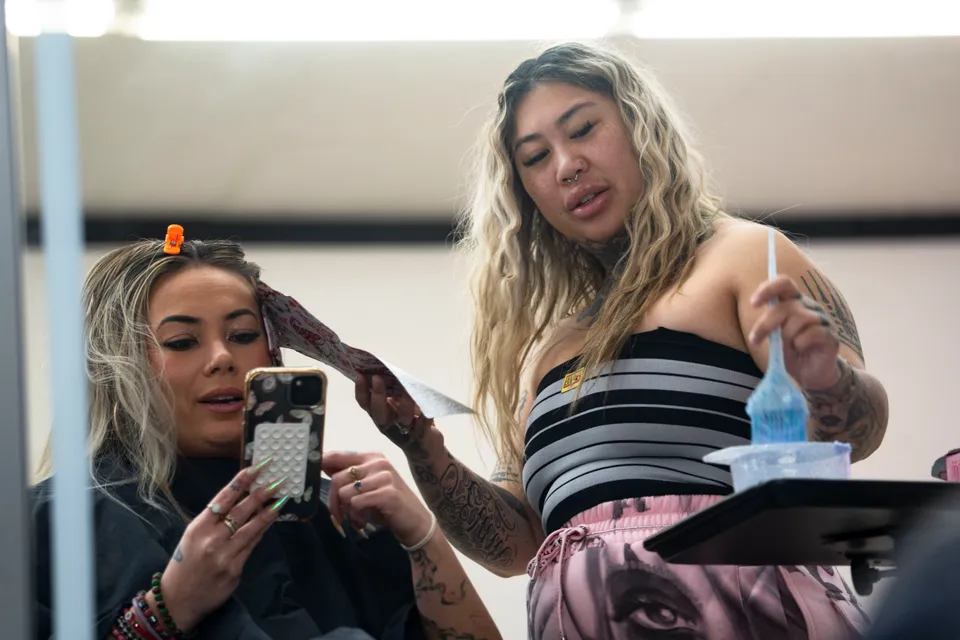
Soda, a hairstylist who manages the salon, said she enjoys the “mini community” of staff and clients at Collective Artistry. As artists and entrepreneurs, Soda and Moreno said they find collaboration with others key in their industry and critical to their development.
The two renovated their shop to include smaller studios intended for budding or seasoned beauty stylists or local entrepreneurs to use and be part of their team.
Lily Smith/The Register
The COVID-19 pandemic, which forced people into social isolation, only proved how important third places were when access was lost through lockdowns and stay-at-home-orders, Drinkwater said.
Loneliness is “far more than a bad feeling,” wrote Dr. Vivek H. Murthy, former U.S. surgeon general, in a 2023 report. People experiencing loneliness and isolation are at greater risk of cardiovascular disease, depression and anxiety. It can be just as fatal as smoking up to 15 cigarettes a day and more harmful than alcoholism, Murthy said in the report.
“A Zoom room is not the same” as meeting in person and talking face to face, Drinkwater said.
Come as you are, as a friend
That was largely why Britney Brown swapped her social media for in-person interactions and opened Glitter Factory DSM, a DIY arts and crafts studio and shop just outside the city’s downtown, last year.
The mother of five was burnt out by the viral stationary business she built during the pandemic and felt disconnected from the hundreds and thousands of TikTok followers she quickly amassed. Her online presence took over her life.
While it kept online customers hip to her products and orders coming, something was missing.
“It’s cool helping people out, but also I had no connection, like one-on-one connection with people,” the 39-year-old said. “I knew that I needed to bring whatever I did back to being where I was at physically.”
Brown spent the last year converting her warehouse at 501 SW 7th St. where she stored planners and other paper products into a multi-room, family-friendly arts and crafts studio. The funky gallery wall of celebrities, bold accent walls, pastel-colored couches and novelty plush pillows are examples of the “dopamine decor” that have brought Glitter Factory to life.
While Brown offers art classes, events and workshops, Glitter Factory also offers a $20 pass for crafters interested in working alone or in small groups. For two hours, they can come to Brown’s space and pick among the projects on her activity tables.
“We’ve built community spaces for kids in classrooms, teaching them to lean on their communities, especially the arts,” Brown said. “Music, art, drama — all of those classrooms for the most part are actually community spaces. They’re the places you go to when you skip class.”
“Glitter Factory is like that,” she added, laughing. “Skip work or come with your work wife and make a bracelet.”
Third places allow people to just be, Drinkwater said. Lowering barriers, especially cost and transportation, do that.
According to Oldenburg, affordability is a tenet of third places.
Lily Smith/The Register
Elsewhere across the city, Phoenix Lee and Luke Dickens each have launched a series of free events for music lovers. Lee, co-founder of the monthly pop-up vintage market DSM Flea and co-owner of the store with the same name at 1201 Keo Way, hosts Club Cafe and partners with Des Moines’ coffee shops to showcase the city’s DJs.
The booze-free event featuring daytime DJ sets follow a popular trend in major cities like Chicago and Los Angeles.
Lee, 28, thought Des Moines should have its own. In December, Lee also held the first meeting for his newly launched series, vinyl book club, at Mars Cafe. More than 30 people gathered to listen and discuss singer-songwriter Dijon’s 2021 album “Absolutely.”
“People do crave the social aspect of going somewhere and just talking about similar things,” he said. “I crave to find people that are into what I’m into but also (want) to learn new stuff, too.
“I get really excited when somebody is like,’ Oh, I know exactly what album you’re talking about.'”
Shared connectedness is priceless.
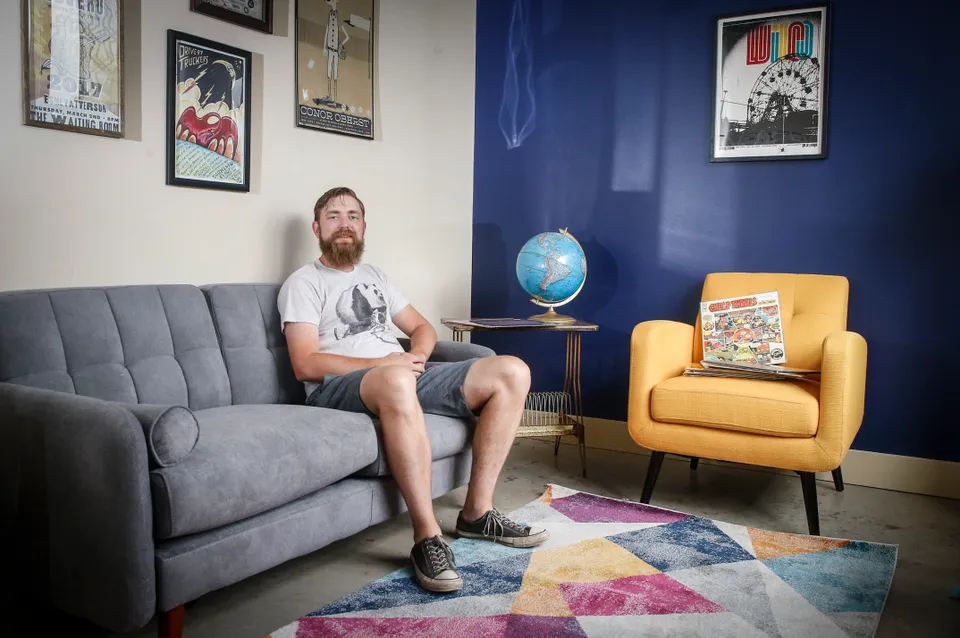
In the back of Dickens’ Beaverdale store is a vinyl listening room where people can play records, hang and be cozy on the mismatched furniture.
Bryon Houlgrave/The Register
Dickens, who started Vinyl Cup in 2017 as a Facebook group, said he opened his record store, now at 2702 Beaver Ave., for those in need of a second home. In 2008, Dickens became sober and found himself retreating to record stores while working on his recovery.
Dickens didn’t have a record player. He found record stores to be the one place he “felt at home.” He could be there for hours by himself or chat with owners or other customers.
“You get to meet new like-minded people that wasn’t an AA meeting,” Dickens, 41, said. “It was different.”
That feeling became the blueprint for his store, which he expanded in May and opened in the former Back Country retail store. It is one of the few third places open until 8 p.m. on weeknights and 9 p.m. on weekends that is not a bar or restaurant. Free coffee, pop, bottled water and other beverages are available at Vinyl Cup. Dickens’ two dogs, Dale and Earl, are fixtures, greeting customers by the door.
With Vinyl Cup, Dickens said the goal was simple: to create “a place where people would feel welcome.”
“I felt it was my obligation,” he said.
Stay in the know with stories that matter — visit HolaAmericaNews.com for the latest news, culture, and community updates!
Facebook Comments