




By Joaquin Ramirez-Andrade
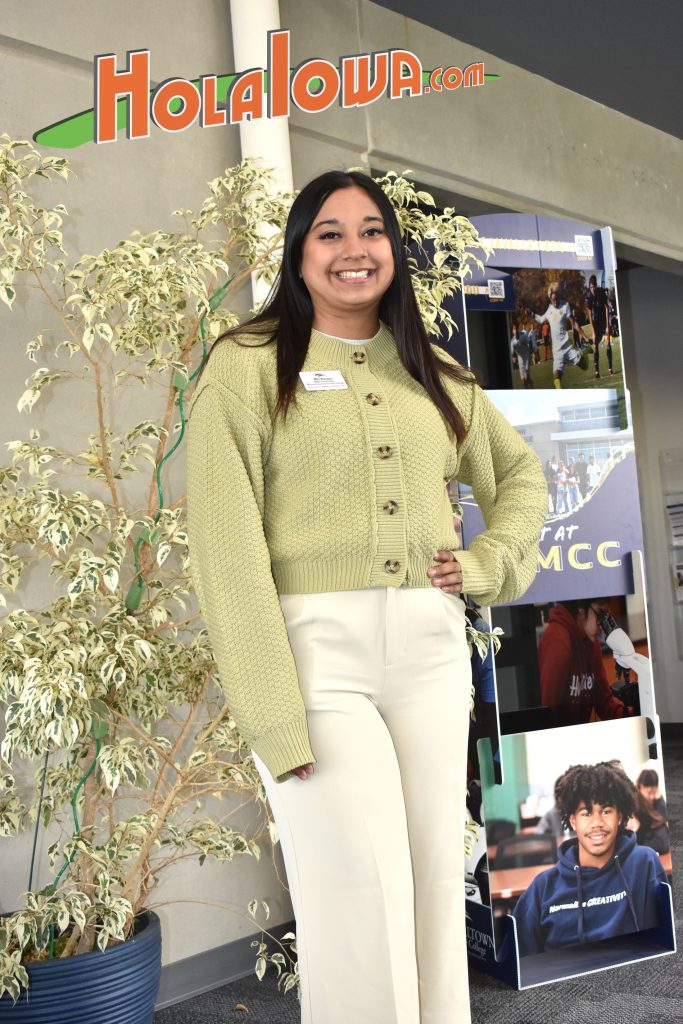
Mia Barajas will be the first to tell you she didn’t plan this. Her degree is in psychology. Her master’s is in marriage and family therapy. She spent years working as a behavior counselor, sitting with students whose lives had handed them more difficulty than most adults could manage. None of that, she thought, was pointing her toward a coordinator’s office at Marshalltown Community College.

But when the position at the Marshalltown Education Partnership opened, something clicked. “I knew it wasn’t necessarily the thing I thought would be in my career path,” she says. “But now I feel like this is exactly where I need to be.”
Mia grew up moving. Born in Sterling, Illinois, she moved to Ottumwa, Iowa, before her family settled in Marshalltown when she was in seventh grade. She credits those early years of starting over, making new friends, and adapting to new schools for the independence and outgoing nature that define her today. “I feel like it helped me become more independent, more responsible, more outgoing,” she reflects. Marshalltown, she says without hesitation, is home.
At Marshalltown High School, she was everywhere: track, cross-country, student senate, and the healthcare career club. She also graduated from MCC through dual credit before she received her high school diploma. That drive to stay busy, to stay connected, never left her. It’s the same energy she brings to her work every day. Ask Mia who influenced her most, and she doesn’t hesitate. “My dad. He has always made a huge impact on every aspect of my life.”
David Barajas is a first-generation college student who once served on the MEP board himself. Growing up, Mia watched her father pour himself into the community; volunteering, mentoring, advocating for young people who reminded him of himself. He talked often about the importance of education, especially for first-generation and low-income students who have no roadmap to follow. “With him being on the MEP board,” Mia says, “I grew up really seeing firsthand how passionate he was about supporting students and creating opportunities for young people in our community.” Mia was never a MEP student herself – she wasn’t a first-generation – but the program’s mission lived in her household long before she ever worked for it.

The Marshalltown Education Partnership is a program built on a straightforward but powerful idea: that every first-generation, low-income student in Marshalltown deserves a clear path forward after high school. Students enter in ninth grade and commit to the program through their sophomore year at MCC. But even those who fall short of the grade requirements don’t lose their connection to Mia. “You can still be in MEP, even if you fall below that GPA line,” she explains. “I will still be there to help you with college applications, resumes, college planning, career exploration; all that sort.”
Right now, Mia is the sole coordinator for 402 students. From High school freshmen to MCC sophomores. She splits her time between Marshalltown High School and the college, making herself available by phone, email, and in person. Some students she sees nearly every day. Others come in a handful of times a semester. She wants all of them to know she’s there.
– A note from the author –
As a first-generation student who walked those same halls at Marshalltown High School, I know what MEP was supposed to be. I also know what it felt like when it wasn’t quite there. During my time at MHS, the program went through a period of instability – coordinators came and went, and for many of us in that class, MEP became something we heard about more than something we used. The scholarship, the guidance, the hand that was supposed to help us figure out what came next; a lot of us missed it, not because we didn’t qualify, but because the program couldn’t hold itself together long enough to reach us.

That’s what makes Mia Barajas different. She didn’t inherit a broken program – MEP has grown considerably since those years – but she stepped into a role that carries the weight of what it means when students fall through the cracks. She knows that, too. “MEP exists just to make sure those first-generation and low-income students know that higher education is possible and can be possible for any of them.”
It’s not always the big milestones that remind Mia why she does this work. Recently, she has been sitting with students who don’t quite meet the GPA threshold for the standard MEP scholarship, but who are applying for a separate award that could still earn them the opportunity. She watches them sit down to write their essays, students who have struggled, who don’t always show up on paper the way their potential shows up in person. “When they actually take the time to write their essay with me, it just makes me feel so good,” she says. “It really reminds me why I’m doing this position.”
Her previous work as a behavior counselor shaped this instinct to look at past surface-level struggles. “I really grew in appreciation for students that may not be the straight-A typical student,” she says. “Everybody has a different story that’s going to shape them. Even if they have a rough past, they are still young enough to make the changes so they can have a better, brighter future.”
Looking ahead, Mia wants to grow MEP’s reach: more students, stronger partnerships with local employers like Emerson and the Marshalltown Company, more real-world internships and experiences that show students what their future could look like. She’s been quietly spreading the word around town, too, including a recent presentation to Marshalltown’s Rotary Club, where she was struck by how many people had never heard of MEP. “Sometimes it makes me upset you guys don’t know what MEP is, but I’m really focusing on just getting MEP out there more and more,” she says with a laugh. A new Facebook page is part of that push.
Her ultimate vision is a full circle: students who come through MEP find their footing, graduate with a plan, and return to invest in the Marshalltown community. Maybe they land an internship with a local company, build a career here, and one day become the kind of person their younger selves needed. It’s a vision, as it turns out, that looks a lot like her own story. A girl who moved to this city without choosing it, who grew roots here anyway, and who is now one of the quieter forces making sure others can do the same.
At the end of the month, Mia will be heading to Cancun to get married. When she comes back, she’ll be right where she said she needs to be – in Marshalltown, showing up for her students.
Stay in the know with stories that matter — visit HolaAmericaNews.com for the latest news, culture, and community updates!
Facebook Comments