



The regular June 1 deadline has passed, but county treasurers may grant extensions. Income rules differ for residents ages 65–69, disabled adults and claimants 70 or older.
By Hola Iowa
IOWA — Iowa homeowners who are 65 or older, or adults with a qualifying total disability, may be eligible for a state property tax credit based on household income.

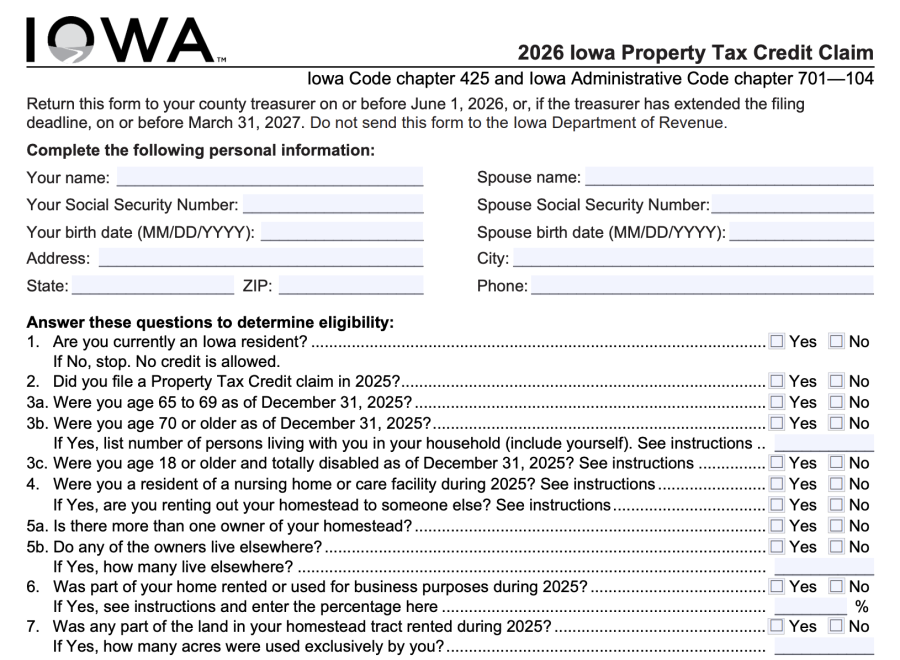
The program is officially called the Iowa Property Tax Credit for Senior and Disabled Citizens. Claims are filed with the county treasurer using Form 54-001, not with the Iowa Department of Revenue.
The regular filing deadline for 2026 was June 1. However, a county treasurer may extend the deadline, with the 2026 state form allowing extensions as late as March 31, 2027. Late filing availability can vary by county, so homeowners applying after June 1 need to check with their own treasurer.

Residents ages 65–69 need household income below $26,895
For the 2026 claim, an Iowa resident who was 65 to 69 years old on Dec. 31, 2025 generally needs total 2025 household income below $26,895 to qualify.
The same standard income schedule applies to adults age 18 or older who qualify based on total disability, unless they also qualify under the separate rules available to claimants age 70 or older.

For the standard calculation, Iowa applies a percentage based on household income:
| 2025 household income | Percentage used in credit calculation |
|---|---|
| $0–$13,854.99 | 100% |
| $13,855–$15,484.99 | 85% |
| $15,485–$17,114.99 | 70% |
| $17,115–$20,374.99 | 50% |
| $20,375–$23,634.99 | 35% |
| $23,635–$26,894.99 | 25% |
| $26,895 or more | No credit under the standard income schedule |
The actual credit is calculated from the property taxes due and the claimant’s income. Qualifying does not automatically mean a homeowner will receive a $1,000 reduction.
Claimants age 70 or older can qualify under higher income limits
Iowa uses a separate income test for homeowners who were 70 or older on Dec. 31, 2025. These claimants may qualify when household income is no more than 250% of the federal poverty level.
| People in household | 2025 household income limit |
|---|---|
| 1 | $39,125 |
| 2 | $52,875 |
| 3 | $66,625 |
| 4 | $80,375 |
| 5 | $94,125 |
| 6 | $107,875 |
| 7 | $121,625 |
| 8 | $135,375 |
For households larger than eight people, Iowa adds $13,750 to the limit for each additional household member.
Claimants age 70 or older should file every year to receive the maximum benefit available under the expanded calculation.
Total disability requires current supporting documentation
A person claiming eligibility based on disability must have been at least 18 years old and totally disabled by Dec. 31, 2025.
For this program, Iowa defines total disability as being unable to engage in substantial gainful employment because of a medically determined physical or mental impairment that is expected to last at least 12 months or result in death.
Applicants younger than 65 who qualify through disability must include current documentation. Iowa accepts:
- a current Veterans Administration statement showing a 100% disability benefit during 2025;
- a current Social Security Administration document showing when the disability began; or
- a written statement from a doctor showing the beginning date of the disability and whether it is permanent or temporary.
Claims submitted without the required disability documentation can be denied. Proof of disability is not required when the claimant was already 65 or older on Dec. 31, 2025.
The application uses 2025 household income, not only taxable wages
Form 54-001 asks for total household income from 2025. The calculation can include more than the amount shown as taxable income on an Iowa income tax return.
The form includes Social Security, disability and workers’ compensation, retirement income, certain government benefits, interest, capital gains, money received from other people living in the household and other applicable income.
Married couples who live together are treated as one household and file one claim using their combined income.
Form 54-001 goes to the county treasurer
Applicants use the 2026 Iowa Property Tax Credit Claim, Form 54-001.
The claim is returned to the treasurer in the county where the property is located. It should not be sent to the Iowa Department of Revenue.
The Iowa County Treasurers Association directory lists county offices and contact information.
Late claims depend on the county treasurer
The regular statewide filing date was June 1, 2026. Iowa’s claim form allows a county treasurer to extend the deadline as late as March 31, 2027.
An extension is not automatic. Someone filing now should confirm directly with the county treasurer whether late 2026 claims are still being accepted and what local deadline applies.
Polk County, for example, currently states that its Treasurer’s Office must receive late 2026 Senior and Disabled Property Tax Credit forms by Dec. 31, 2026.
This credit is different from the Homestead Exemption
The Senior and Disabled Property Tax Credit directly reduces eligible property taxes based on age or disability, household income and the state calculation.
Iowa’s Homestead Exemption is a separate program. Beginning with the 2026 assessment year, Iowa replaced the former homestead credit with an exemption equal to 10% of taxable homestead value, subject to a minimum and maximum.
A homeowner can therefore encounter both programs, but they have different eligibility rules, filing procedures and calculations.
Related: Iowa replaced its homestead tax credit with a 10% exemption: what homeowners get
Renters use Rent Reimbursement instead of the homeowner credit
This property tax credit is designed for qualifying homeowners. Iowa renters do not claim their rent through Form 54-001.
Eligible renters who are 65 or older or have a qualifying total disability may instead use Iowa’s separate Rent Reimbursement program, which reimburses part of qualifying rent paid.
Related: Iowa Rent Reimbursement 2026: who may qualify for up to $1,000 and how to apply
Questions about a property tax credit claim should go to the county treasurer responsible for the property. The regular June 1 deadline has passed, so applicants seeking a 2026 credit should confirm whether their county is still accepting late claims before submitting the form.
Stay in the know with stories that matter — visit HolaAmericaNews.com for the latest news, culture and community updates!
Facebook Comments