



Railroad and foundry workers built communities in Davenport, Bettendorf and Silvis during the early 1900s, establishing family networks that later supported civil rights organizing, education and military service.
By Hola America News
Cook’s Point, Holy City and La Yarda were once home to hundreds of Mexican workers and their families along the riverfront and railroad corridors of the Quad Cities.

The neighborhoods developed during the early 20th century, when the Mexican Revolution displaced families and industrial employers in the United States faced labor shortages. Foundries and railroad companies recruited Mexican workers for jobs in Bettendorf, Davenport and Silvis.
Many families settled in segregated areas near the factories and railroad tracks where they worked. Their homes included small cottages, shacks, houseboats and converted boxcars, often without electricity or indoor plumbing.
The neighborhoods also supported music, religious traditions, gardens, baseball teams and close family networks. Those connections continued after Cook’s Point, Holy City and La Yarda disappeared or changed beyond their original form.
Holy City grew beside Bettendorf’s foundries
Holy City occupied a stretch of land between the Mississippi River and the railroad tracks in Bettendorf. Its earliest Mexican residents included workers recruited by the Bettendorf Company during World War I to fill jobs in its foundry.

The company provided a rent-free residential area near the plant with cottages, apartments and boxcars. By 1925, Holy City had become a predominantly Mexican community whose residents worked primarily as pieceworkers and day laborers.
Living conditions were difficult. Former residents recalled boxcars with cardboard covering the window openings, kerosene lamps for light, coal-burning stoves for heat, a shared water pump and outdoor toilets.

Families also raised chickens and goats, planted gardens and organized music throughout the neighborhood. Children collected fallen coal near the tracks during winter, played near the river and learned Spanish and music from relatives and neighbors.
Cook’s Point became a Davenport address
Cook’s Point existed as a predominantly Mexican settlement on Davenport’s southwest side from the 1910s until 1952. It stood between the railroad tracks and the Mississippi River, much like Holy City farther upstream.
The neighborhood was established enough that “Cook’s Point” alone could serve as a mailing address. Families lived in boxcars, cottages, shacks and houseboats, generally without indoor plumbing or electricity. Flooding created another recurring problem for homes closest to the river.
Residents built a community around extended families, church traditions, reunions and baseball. The Mexican Aces, a team connected to Cook’s Point, won a Davenport city championship.
Davenport cleared Cook’s Point for industrial development in 1952. Families received eviction notices and had to find housing elsewhere at a time when Mexican residents faced discrimination from landlords and neighborhoods.
Members of the Ramirez family purchased land on Davenport’s west end and built several homes for relatives. The area became informally known as Ramirezville. Former Cook’s Point families continued holding reunions and preserving photographs, maps and stories from the neighborhood after its demolition.
La Yarda connected railroad work to Hero Street
Across the Mississippi River, Mexican families formed another community inside the Rock Island Railroad yards in Silvis. The settlement became known as La Yarda.
At its peak during the 1920s, about 400 Mexican residents lived in three adjoining sections of the railroad yards. Many families occupied converted boxcars while working for the railroad.
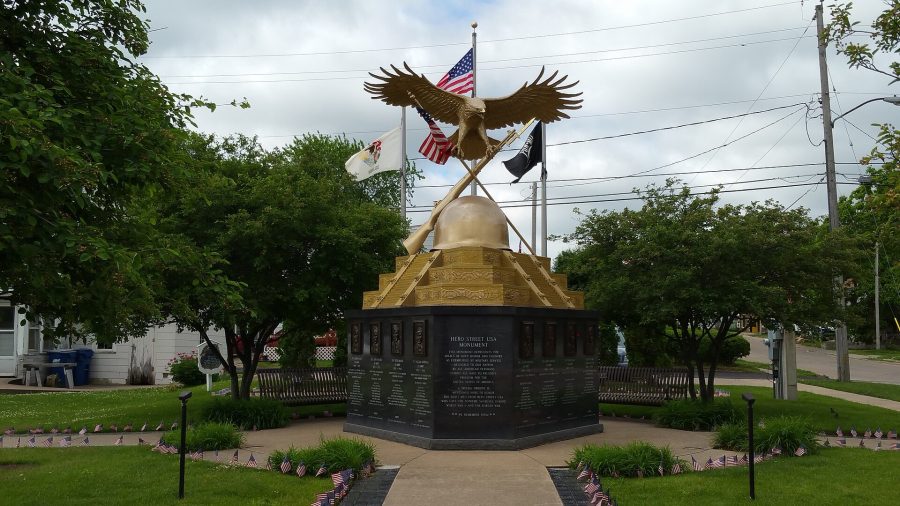
After leaving La Yarda, families settled nearby, including along Second Street. That short street eventually became one of the country’s best-known Mexican American military communities.
Six men from the street died during World War II and two more during the Korean War. Silvis renamed Second Street as Hero Street in May 1967. Hero Street Memorial Park was dedicated in 1971 to preserve the names and stories of the eight servicemen.

LULAC Council 10 carried the history into civic life
The children and grandchildren of the region’s early Mexican workers established organizations that addressed discrimination, education and access to public institutions.
LULAC Council 10 received its charter in Davenport on Feb. 16, 1959. Many of its organizers were second- and third-generation Mexican Americans whose parents had come to the area for railroad and foundry work.
The council advocated for fair housing, employment protections and a full-time director for the Davenport Human Relations Commission. Its members supported bilingual education in Davenport schools, organized scholarships for Mexican American students and formed the Quad City Grape Boycott Committee during the late 1960s.
Council 10 also helped secure the creation of the Iowa Spanish Speaking Peoples Commission in 1976. The council’s records now document decades of local activism, education programs, community celebrations and scholarship work.
Related: How LULAC Council 10 grew from Davenport’s Mexican American community
The neighborhoods remain part of the public record
Photographs, oral histories and family papers from Cook’s Point, Holy City and La Yarda are preserved by the Iowa Women’s Archives. The Davenport Public Library also maintains a Latinx History in the Quad-Cities research guide connecting local histories, archival collections and recorded interviews.
Hero Street remains a physical part of Silvis, with a memorial park honoring the eight servicemen. The University of Iowa’s collection of LULAC Council 10 records, spanning materials from 1930 through 2025, is open for research.
Stay in the know with stories that matter — visit HolaAmericaNews.com for the latest news, culture and community updates.
Facebook Comments