




By Rachel Cramer, Iowa Public Radio
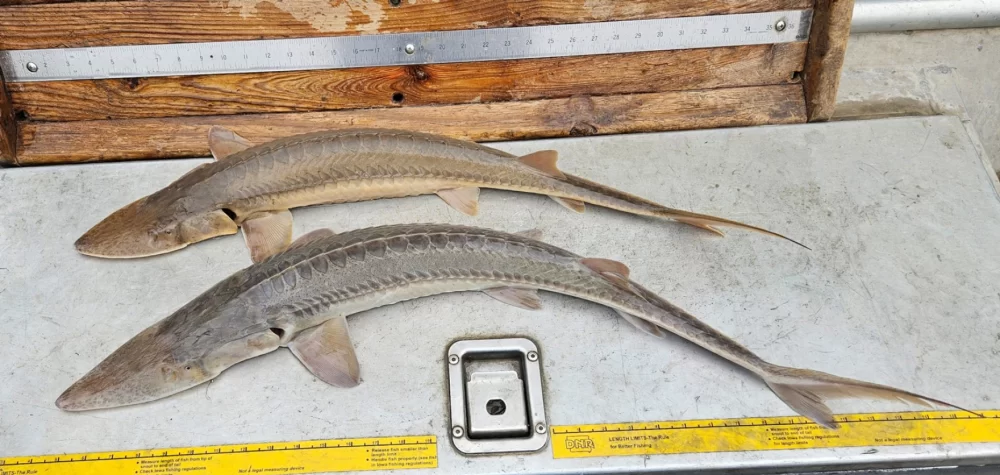
The two wild fish were captured near the Ottumwa dam about a week apart in spring 2025, giving biologists the first verified records of the endangered species in the river.
Updated Aug. 6, 2026, with current Iowa DNR guidance and findings published after the original report.

OTTUMWA, IA — Two rare fish that reached Ottumwa in spring 2025 gave Iowa biologists something they had never recorded in the Des Moines River before: wild pallid sturgeon.
The Iowa Department of Natural Resources captured the two fish below the Ottumwa Hydropower Dam during its annual sturgeon survey. Genetic testing confirmed that both were pallid sturgeon produced in the wild rather than raised and stocked by a hatchery.

The discovery provided the first scientifically verified records of the federally endangered species in the Des Moines River.

The finding was later documented in a peer-reviewed study published in the Journal of Applied Ichthyology. Researchers described the appearance of the fish as a possible expansion of the pallid sturgeon’s known modern range.
Two wild pallid sturgeon appeared near Ottumwa
The first fish was captured on April 28, 2025, and measured nearly 32 inches. The second was found on May 6 within approximately 300 meters of the first and measured close to 31 inches.

Neither fish had a tracking tag or the missing body plates that can indicate a previous capture. Genetic testing found no evidence that either came from a conservation hatchery.
That distinction made the discovery particularly unusual. Nearly nine out of every 10 pallid sturgeon collected from Iowa’s portion of the Missouri River originated in a hatchery, according to the Iowa DNR.

Annual surveys of the lower Des Moines River began in 2014. Biologists had previously collected shovelnose sturgeon and an occasional lake sturgeon in the area, but no confirmed pallid sturgeon.
The two fish do not establish that the river contains a self-sustaining pallid sturgeon population. They do show that wild members of the species can reach and use a part of the river where their presence had not previously been documented.
Spring flows may have carried the fish from the Mississippi River
Researchers believe the pallid sturgeon likely entered the Des Moines River from the Mississippi River during a period of higher spring flows.
Both apparently continued upstream until they reached the Ottumwa Hydropower Dam, which limits fish passage. They were captured over a hard river bottom containing large limestone rocks, a type of habitat that may attract sturgeon preparing to spawn.
Rising water levels and warmer spring temperatures can prompt pallid sturgeon to travel upstream in search of suitable spawning areas. Adults may migrate 100 miles or more during the reproductive season.
If spawning succeeds, newly hatched fish drift downstream with the current, sometimes traveling hundreds of miles before becoming strong enough to swim against it.
The Ottumwa discovery suggests that the Mississippi River and its large tributaries may be used by pallid sturgeon more often than existing records show.

Pallid sturgeon can live for more than 80 years
Pallid sturgeon belong to one of the oldest families of fish on Earth. Their form has changed little over tens of millions of years, contributing to their reputation as prehistoric or ancient fish.
Instead of conventional scales, rows of hard plates called scutes protect their bodies. Their skeletons are made primarily of cartilage, and their toothless mouths extend downward to collect insects, small fish and other food from the riverbed.
The fish are adapted to deep, murky rivers. Whisker-like sensory organs called barbels help them locate prey in water where visibility is limited.
Pallid sturgeon can live for at least 80 years and grow to approximately 6 feet. Females generally do not reach reproductive maturity until they are between 15 and 20 years old.
The species’ slow growth and late reproduction make it difficult for depleted populations to recover.
How to tell pallid and shovelnose sturgeon apart
Pallid and shovelnose sturgeon can look similar, but anglers can examine several characteristics to distinguish them:
- Color: Pallid sturgeon generally have a pale gray or whitish appearance.
- Snout: Their snouts tend to be longer and more sharply pointed than those of shovelnose sturgeon.
- Belly: Pallid sturgeon have a smooth belly without scales. The belly of a shovelnose sturgeon is covered with rough, plate-like scutes.
- Barbels: A pallid sturgeon’s two outer barbels are considerably longer than the inner pair and form a curved arrangement. A shovelnose sturgeon has four barbels of approximately equal length arranged in a straighter line.
- Size: Pallid sturgeon can grow substantially larger, although size alone is not enough to confirm the species.
Mark Flammang, an Iowa DNR fisheries management biologist, urged anglers on the Des Moines River and larger tributaries of the Upper Mississippi River not to assume automatically that every sturgeon is a shovelnose.

Anglers must release pallid sturgeon immediately
Fishing for pallid sturgeon is prohibited because the species is protected under the federal Endangered Species Act.
Anyone who catches a pallid sturgeon must return it to the water immediately and with as little injury as possible. Lake sturgeon must also be released.
Of Iowa’s three sturgeon species, only shovelnose sturgeon may be eligible for harvest, subject to current state fishing regulations.
Because the protected pallid sturgeon closely resembles the shovelnose, anglers should release any fish they cannot identify with confidence.
Possible pallid sturgeon catches can be reported to the Iowa DNR at 515-725-8200.
Scientists recommend more surveys in the Des Moines River
The two fish have given researchers a reason to conduct more targeted sampling in the lower Des Moines River and examine how pallid sturgeon move between the river and the Mississippi.
Additional surveys could help determine whether the 2025 captures involved two isolated visitors or whether wild pallid sturgeon use the river more regularly.
Biologists also want to learn whether the river still contains suitable spawning habitat for the species.
Major obstacles remain. Dams have interrupted historic migration routes and altered the seasonal river flows needed by adult fish and drifting larvae. The Des Moines River has also faced water quality concerns tied to high nitrate levels. Low water levels combined with high temperatures have contributed to the deaths of tens of thousands of shovelnose sturgeon in the lower Des Moines River during the past three decades.
The presence of two wild pallid sturgeon does not mean the endangered species has recovered. It does show that even a heavily altered river can still provide habitat for one of North America’s rarest fish.
Stay in the know with stories that matter — visit HolaAmericaNews.com for the latest news, culture and community updates!
Facebook Comments