




By Stephen Gruber-Miller, Des Moines Register
Iowa Republicans are considering changes to eligibility for public assistance programs such as SNAP in two bills moving forward in the Legislature.

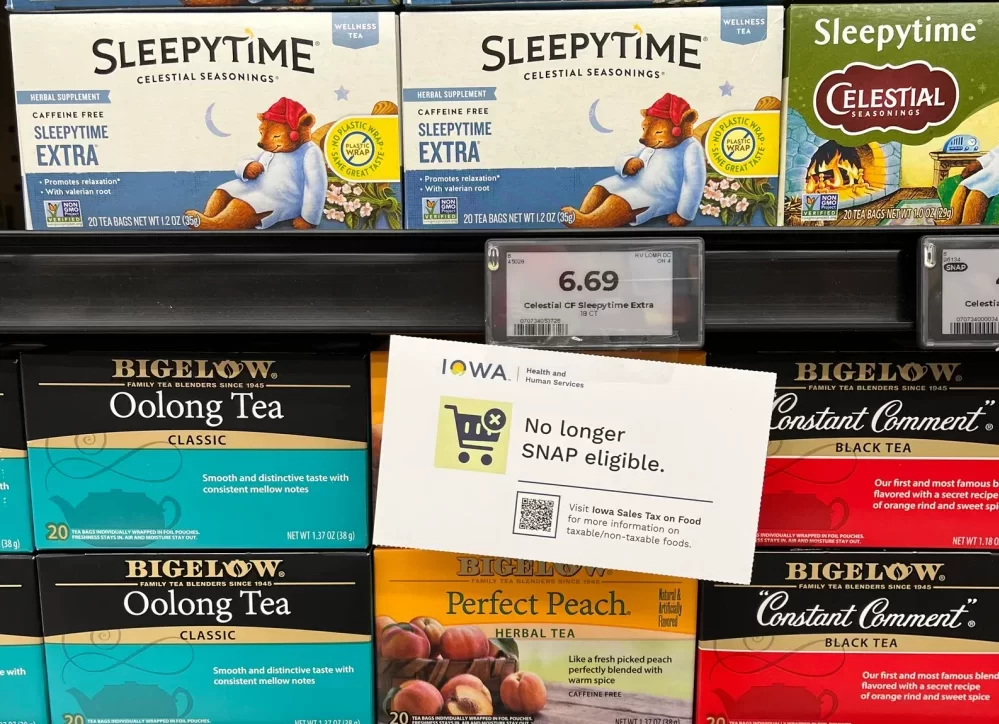
Gov. Kim Reynolds wants the state to continue seeking a waiver from the U.S. Department of Agriculture that prevents Iowans from using food assistance dollars to buy unhealthy foods such as pop, candy and more.
House Study Bill 694, which a three-member House subcommittee approved Feb. 12, says the state must seek to maintain Iowa’s existing waiver for the Supplemental Nutrition Assistance Program (SNAP) and for the Summer EBT program.
Another bill, House Study Bill 696, would make several changes to public assistance programs in Iowa, including by restricting eligibility for some programs to U.S. citizens and requiring recipients to live in Iowa for one year before they could access benefits.
Gov. Reynolds’ bill would require healthy food SNAP waiver from USDA
Iowa’s waiver for SNAP and for the Summer EBT program for low-income children prevents Iowans from using their benefits to buy pop or candy, while also restricting some prepared foods.

The waiver took effect Jan. 1. Reynolds’ bill seeks to make it permanent.
“This year, I’m asking the Legislature to make sure our state always maintains a nutrition first focus for these programs by directing the Iowa HHS to maintain a federal waiver going forward,” she said Jan. 13 in her Condition of the State address.
Luke Elzinga, chair of the Iowa Hunger Coalition, said Iowa’s SNAP waiver has been “incredibly confusing and stigmatizing” for SNAP recipients to navigate in its first six weeks.
He said tying SNAP eligibility to Iowa’s taxable food list, as Iowa’s waiver does, “has essentially told SNAP participants that they need to be an expert in the tax code.”

“Pedialyte is now banned from SNAP,” he said. “Yogurt covered raisins are out. Prepackaged sandwiches and salads are banned in certain instances. A fruit cup sold with a spoon attached by the seller is now banned from SNAP.”
Paige Chickering, Iowa state manager of Save the Children Action Network, said the bill requires an evaluation after Iowa’s waiver has been in effect for two years and urged lawmakers to wait before making the rules permanent.
“It would be a really smart decision to possibly wait until after we have that evaluation and that data to see whether or not the waiver is actually having the desired effects that we’d like to see it have on healthy eating and improving those outcomes,” she said.
Elzinga and Chickering said they believe the bill is written in a way that would end Iowa’s participation in SNAP if the federal government does not continue to grant the state a waiver, although the bill says that the state shall “ensure that the provision of SNAP benefits to recipients is uninterrupted.”
A spokesperson for Reynolds’ office said SNAP would not end without a federal waiver, but the state’s participation in Summer EBT is conditioned on one.
The bill would also:
- Allow Iowans to buy ivermectin over the counter without a prescription.
- Ban certain food dyes from school meals and drinks.
- Raise taxes on cigarettes by 65 cents per pack and tax vapes and other tobacco products. However, lawmakers said they would remove the portion of the bill dealing with taxes and consider it in separate legislation.
Rep. Austin Harris, R-Moulton, said there would be “a large amendment” when the bill comes before the full Health and Human Services Committee that will take out the bill’s tax provisions and make other changes.
“This bill still has some work to be done to it,” he said. “But we look forward to the conversations.”
Changes for WIC would exclude undocumented immigrants, other noncitizens
Lawmakers also advanced House Study Bill 696, a wide-ranging bill dealing with public assistance programs.
Among other changes, the bill restricts eligibility for the federal Women, Infants and Children (WIC) program to “qualified aliens” as defined in federal law. That would exclude undocumented immigrants, as well as holders of temporary protected status and Deferred Action for Childhood Arrivals (DACA).
The bill also requires SNAP and WIC recipients, as well as people receiving state child care assistance and other benefits, to prove they have lived in Iowa for 12 months before they can claim benefits, unless doing so would be prohibited by federal law.
Tom Chapman, executive director of the Iowa Catholic Conference, said his organization does not support the changes to WIC based on immigration status.
“We want all children to thrive and all moms to thrive,” he said. “I would just note that in the bill you’re not just disqualifying undocumented people but also people who have temporary protected status or some other work authorization.”
Harris said “this bill aims to protect the integrity and stability of these programs to make sure that they’re focused on supporting Iowans that most need them.”
“Iowa is not going to be a sanctuary state for waste, fraud and abuse,” he said.
Stay in the know with stories that matter — visit HolaAmericaNews.com for the latest news, culture, and community updates!
Facebook Comments