




By Hola America
May 1, 2026, marks twenty years since the Day of Unity March, one of the most important public moments for the Latino community in the Quad Cities.

On May 1, 2006, nearly 3,000 people came together dressed mostly in white, many carrying American flags. They crossed the Centennial Bridge with a clear message: they wanted to be seen, heard and recognized as part of the community they helped build.
They were marching against H.R. 4437, a proposed federal bill that would have treated undocumented immigrants as felons. For families who were already living with fear and uncertainty, the bill felt like something more than policy. It felt personal.
The march did not begin as something large or polished. It started with a small group of people meeting around a dining room table, trying to figure out what they could do. Young people were part of it from the beginning. Some were still in high school. They did not have years of organizing experience. They had urgency. They had anger. They had hope.
“We were a small group. We would gather in the dining room of my house—that’s where we met while trying to organize the march. Part of the group were just high school students, but even though they lacked experience, they showed a lot of passion,” said Tar Macias, editor of Hola América.

That passion carried the march farther than many expected.
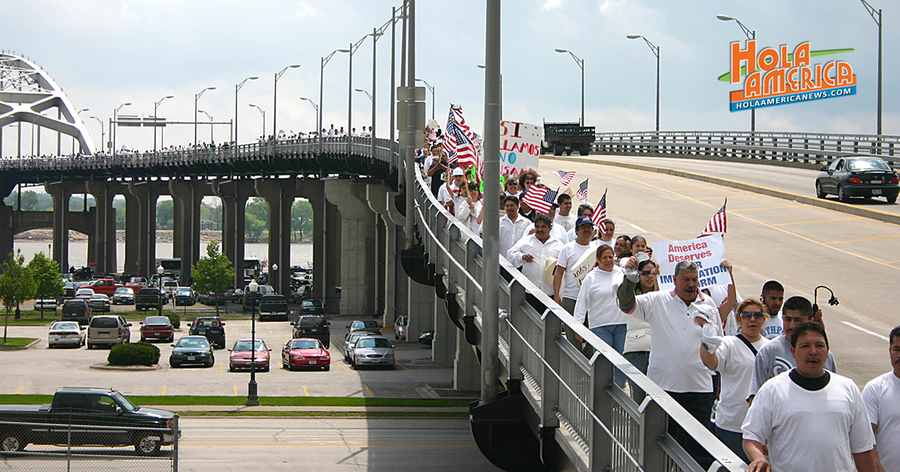
Photo by Tar Macias / Hola America Photo Archives
What began as a grassroots effort grew with the support of local organizations, families and Spanish-language media. By the time people walked across the bridge, it had become a public statement from a community that was often asked to stay quiet.

For many who were there, it was the first time they felt that kind of power. Not private strength. Not survival behind closed doors. Public power. The kind that comes from looking around and realizing you are not alone.
H.R. 4437 ultimately did not become law. The bill passed the U.S. House of Representatives but stalled in the Senate and never reached the president’s desk. For many who marched, that felt like a victory. It was proof, or at least something close to proof, that raising your voice could matter.

But the years that followed also made something else clear: one defeated bill was not the same as justice.
The fight continued.
In 2012, the federal government created Deferred Action for Childhood Arrivals, known as DACA. The program offered temporary protection from deportation to certain undocumented immigrants who had arrived in the United States as children. It allowed recipients to apply for work permits, continue their education and build careers in the country they had long called home.
For many Dreamers, DACA changed the shape of daily life. It opened doors to college classrooms, professional licenses, jobs, homes and futures that had once felt out of reach. Across the country, DACA recipients became teachers, healthcare workers, business owners, advocates and leaders.
That progress was real.
It was also incomplete.
DACA was created through executive action, not through Congress. That meant the program was always vulnerable. In 2017, it was targeted for termination, setting off years of legal battles. Many current recipients have been able to renew their status, but new applications are not being processed by U.S. Citizenship and Immigration Services. Younger immigrants who might have qualified are still left waiting.
Today, DACA remains in place, but its future is unsettled. It sits in the courts, in Congress, and in the lives of people who have had to plan their futures in two-year increments.
For millions of others, DACA was never available at all.
Parents, essential workers and longtime residents, including many who marched in 2006, did not qualify because of age limits or other requirements. They kept working, raising families, paying taxes, building neighborhoods and showing up for their communities, still without a path to legal status.
That is the part that cannot be softened too much. Twenty years later, the broader immigration reform many hoped for has not happened.
The country has changed since 2006, but not always in ways that made life easier for immigrant families. The national conversation around immigration has become louder, more divided and often less honest. Politics and misinformation have made it harder to talk about people as people.
For many families, the fears are familiar: separation, limited opportunities, legal uncertainty and the pressure of living carefully in a place that is also home.
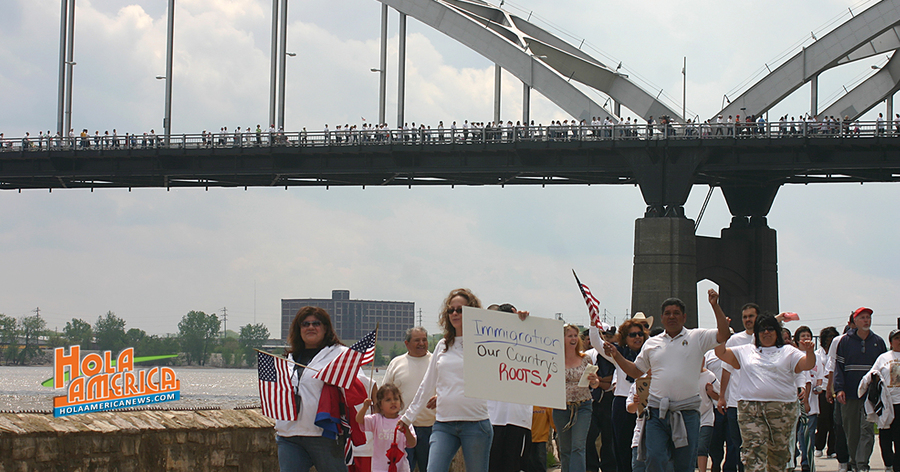
Photo by Tar Macias / Hola America Photo Archives
And still, the community has moved forward.
The students who helped organize, marched or watched their parents cross that bridge are adults now. Many have become professionals, advocates, parents and community leaders. Latino communities across the Midwest are more visible than they were twenty years ago. They are more organized, more engaged and harder to ignore.
Media platforms like Hola América have also helped preserve that history. They have documented the moments that might otherwise be treated as small, local or temporary, even when they carry the weight of a whole generation.
There is also a broader recognition now of how deeply immigrant communities shape this country. They shape its economy, its schools, its small businesses, its food, its music, its churches, its neighborhoods and its future. Not everyone says that out loud. Not everyone agrees. But the evidence is everywhere.
The Day of Unity March belongs to that history.
It was a march, yes. But it was also a before-and-after moment for many people in the Quad Cities. It showed what could happen when families, students, workers, organizers and local media moved together. It showed a community discovering its own voice in public.
The bridge mattered because people crossed it together.
Twenty years later, that image still holds: white shirts, flags, families, young people, elders, fear, pride, and a demand to be treated with dignity.
In 2006, the message was simple: Ayer marchamos. Yesterday we marched.
Today, the message is not exactly the same. It cannot be. Too much time has passed. Too many families have waited. Too many promises have been delayed or broken.
But the urgency remains.
The march is now part of the past, but the need for a lasting solution is not. The bridge was crossed twenty years ago. The work continues on this side of it.
Stay in the know with stories that matter — visit HolaAmericaNews.com for the latest news, culture, and community updates!
Facebook Comments