
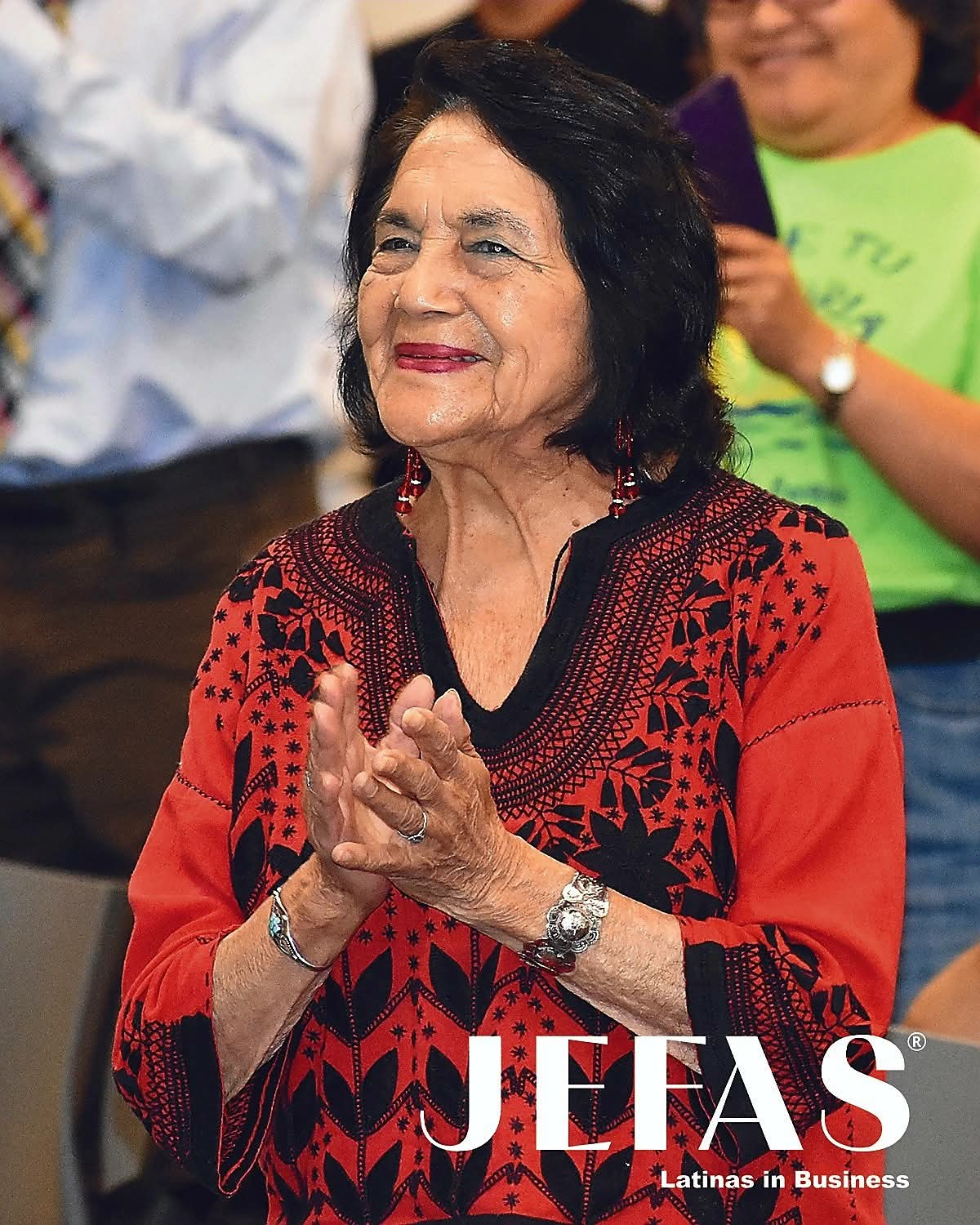



The civil rights leader visited Des Moines in 2019, meeting community advocates and organizers. Her “Sí Se Puede” slogan also inspired a 2026 cultural celebration in Iowa.
By Hola America News
Dolores Huerta, the labor organizer and civil rights leader who helped build the United Farm Workers movement, died Wednesday, Oct. 28, 2026, at her home in Bakersfield, California. She was 96. Her death marked the end of a career that transformed conditions for agricultural workers and extended to women’s rights, civic participation and community organizing across the United States.

Huerta’s family confirmed her death and requested privacy. Plans for public events recognizing her life will be announced later.
Her work also brought her to Iowa. In September 2019, Huerta visited Des Moines, where she took part in gatherings involving educators, nonprofit organizations and advocates working on labor rights, equal opportunities and civic participation.
Dolores Huerta visited Des Moines in September 2019
The Chrysalis Foundation selected Huerta as the featured speaker for its Sept. 20, 2019, INSPIRED event at the Hilton Des Moines Downtown. The appearance was part of the organization’s 30th-anniversary activities, focused on expanding opportunities for girls and women in central Iowa.
Huerta was 89 at the time and continued traveling around the country to speak about labor organizing, civil rights and leadership. Her visit also included a tribute hosted at Des Moines University in partnership with the Chrysalis Foundation.

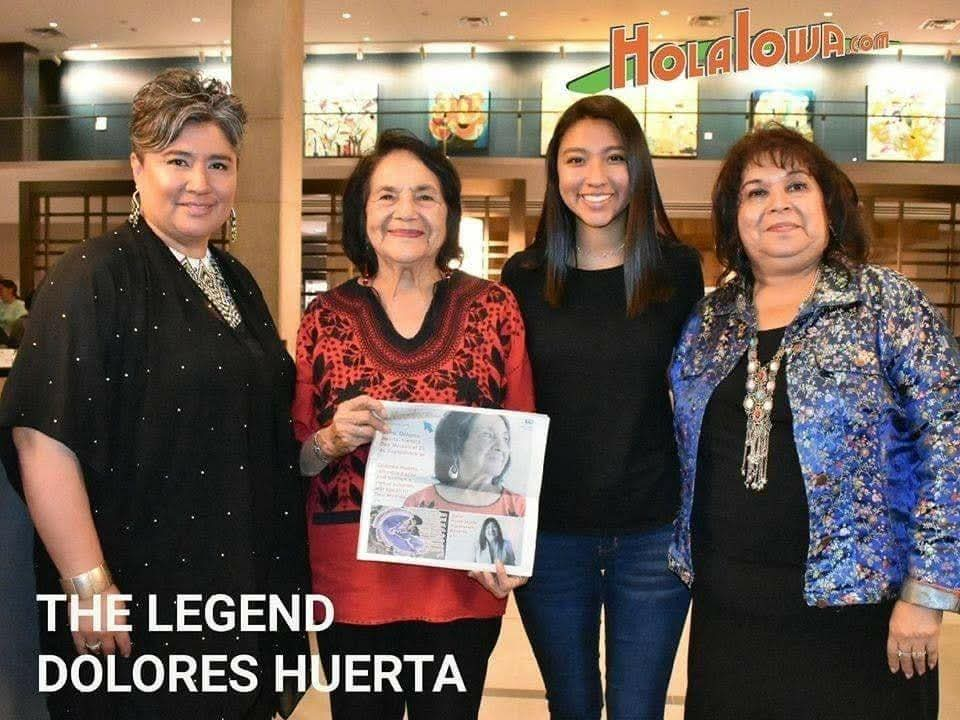
The university’s Office of Diversity and Multicultural Affairs and Medical Students for Latino Health Club helped organize the campus gathering.
Speakers included Ila Plasencia, a former national vice president of the League of United Latin American Citizens (LULAC); Prakash Kopparapu of the Iowa Asian and Latino Coalition; Lena Robison of Latino Unidos of Iowa; Daniel Hoffman-Zinnel of Proteus Inc.; and Joshua Barr, then director of Des Moines Civil and Human Rights.
Huerta discussed how organizing efforts that began with small groups of farmworkers grew into marches and consumer boycotts involving thousands and eventually millions of supporters.

She also urged the audience to participate in addressing social problems, telling those gathered: “We all have to get involved.”
Related: Dolores Huerta’s 2019 INSPIRED appearance in Des Moines

Her 2019 visit brought her together with leaders from Iowa and the Quad Cities
Huerta’s connections to the region are also preserved in photographs and stories published by Hola Iowa and Hola America.
One photograph taken by Tar Macias in 2019 shows Huerta with Joe González, a longtime Des Moines community leader and former police officer who helped develop outreach between law enforcement and Latino residents. González later served as director of Iowa’s Latino Heritage Festival and was recognized by dsm Magazine as one of its 2023 Sages Over 70.
Huerta also reunited with Eva Savala, a longtime organizer from Rock Island County, Illinois. The two women had previously been friends and roommates. Their reunion at a 2019 event in Des Moines was documented in a photograph published by Hola America in 2021.
Savala’s organizing work has included labor representation, voter registration and political participation in the Illinois Quad Cities.
Related: Joe González honored among Des Moines’ 2023 Sages Over 70
Related: Hola America remembers women leaders, including Eva Savala
Huerta helped win labor contracts and protections for farmworkers
Born April 10, 1930, in Dawson, New Mexico, Huerta grew up in Stockton, California. She worked as a teacher before dedicating herself to community organizing, influenced by the poverty and difficult living conditions facing agricultural workers and their children.
In 1962, Huerta and César Chávez founded the National Farm Workers Association. Three years later, Filipino farmworkers led by Larry Itliong began a strike in the vineyards of Delano, California. The association joined the campaign, which expanded into a national boycott of table grapes.
The organizing efforts eventually helped establish United Farm Workers (UFW). Huerta played a leading role in building public support for the boycotts and negotiating contracts that improved wages, health benefits and workplace conditions.
She also contributed to the passage of California’s Agricultural Labor Relations Act of 1975, which established collective bargaining rights for agricultural workers in the state.
In 1972, during a union organizing campaign in Arizona, Huerta coined “Sí Se Puede”—a phrase that became associated with labor and civil rights campaigns far beyond the farmworker movement.
President Barack Obama awarded Huerta the Presidential Medal of Freedom in 2012, recognizing her decades of work as a labor organizer and advocate for civil rights.
Des Moines Art Center chose “¡Sí Se Puede!” as its 2026 Día de los Muertos theme
Huerta’s words remain part of cultural programming in Iowa. The Des Moines Art Center selected “¡Sí Se Puede!” as the theme of its 26th annual Día de los Muertos celebration, scheduled for Sunday, Nov. 1, 2026, from 11 a.m. to 3 p.m.
The free event at 4700 Grand Ave. in Des Moines will explore civil and human rights through art, music, dance and remembrance. Admission is free, and no registration is required.
The Des Moines Art Center celebration includes a community ofrenda, bilingual storytelling, mariachi music, dance performances, art activities and a documentary honoring Felicia Timotea Leon Mullin, the event’s designated honoree. A free shuttle will operate from Merrill Middle School.
The Art Center announced the theme on Oct. 15, nearly two weeks before Huerta’s death. The celebration was not originally organized as a memorial for her; its theme was already inspired by the phrase she created during the farmworker movement.
Related: Day of the Dead 2026 in Iowa: Events in Des Moines, Davenport and More
Her advocacy continued through the Dolores Huerta Foundation
Huerta established the Dolores Huerta Foundation in 2003 to support grassroots leadership, community organizing and civic participation. She continued speaking publicly about workers’ rights, women’s equality and social justice into her 90s.
In March 2026, Huerta publicly disclosed that she had been sexually assaulted by Chávez during the 1960s. Her statement followed a New York Times investigation into allegations of sexual abuse involving the late union leader. Huerta said she had remained silent for decades because she feared damaging the farmworker movement, which she maintained belonged to the workers and organizers who built it.
Following her death on Oct. 28, Huerta’s family said plans to recognize and celebrate her life would be shared at a later date.
Stay in the know with stories that matter — visit HolaAmericaNews.com for the latest news, culture and community updates!
Facebook Comments