





By Courtney Crowder, Des Moines Register
Leading the C-suite of a convenience store corporation may not seem like relevant work experience for taking the helm at the Boys & Girls Clubs of Central Iowa, but, please, let Tanner Krause explain.

Yes, the scale is different. Kum & Go, the aforementioned enterprise, had some 400 outlets across a dozen or so states, while Boys & Girls Clubs operates eight sites within Des Moines city limits.
And constituent motive certainly contrasts, too: Selling gas and coffee and pizza slices and branded merchandise in a classic retail sense versus a nonprofit model focusing on youth growth and development.

But the similarities — groups of employees and clients in distributed sites across a marketplace delivering an essential service — are what made Krause think he could help. And, eventually, it is what encouraged him to raise his hand to take on the interim CEO position, his first major role since Kum & Go was sold in fall 2023.

“I had experience managing operations and building culture when I was at Kum & Go,” says Krause, who was the chain’s president and then CEO for about six years.
“So, I’ve been able to step in here, build off of that expertise and tweak for the fact that we’re now doing explicitly mission-based work,” Krause says. “We’re not quite two months into my interim period, but I feel like momentum is building.”

That energy, the dynamism of it all, will be key to the future of the Boys & Girls Clubs, which, like many nonprofits, is at a critical juncture. In the mire of these uncertain times, charitable giving has decreased — from corporations and people alike.

Add that federal funding has contracted “significantly” in the past few years and Iowa being among only a handful of states that does not allocate tax revenue for Boys & Girls Clubs, and this already small organization has had to remain incredibly nimble, Krause says.

“We are in a period now where we are thinking: How do we get creative?” Krause says. “How do we have a really good strategy in place to continue to grow and to meet the demand? And how do we better engage the community?”
Important questions, sure, but made all the more pressing because the cruel teeter-totter of volatility that despite philanthropy being down, need is up.
In Des Moines, more families in more neighborhoods need more access to high-quality childcare — preferably the sort that isn’t just ensuring safety but also providing opportunities for academic, personal and emotional growth.
And the club sites, like many local food pantries, are also seeing an increased demand for food, either through their hot evening meals — of which they served 60,000 last year — or through their take-what-you-need storerooms that fill voids over weekends or between pay checks.
Whether childcare, workforce retention and development, hunger, sustained academic achievement, mental health support and building stronger community connections, the structure and programming of the Boys & Girls Clubs touches some of the region’s biggest concerns — all of which need some form of more.
“I believe these are solvable problems,” says Krause, echoing the gumption he had in his other CEO office where he transitioned Kum & Go’s staff from 25% full-time to 75%, increased wages for frontline workers and oversaw giving millions in bonuses to full- and part-time employees.

“We live in the richest civilization in the history of humankind,” he says. “If we can engage with politicians, with people who have capacity to share their wealth with us, with people who have the greatest need in our community, and with the big-hearted individuals who choose this as their career, if we can get those constituents together, we can solve these problems.”
And he knows that in the face of headwinds, you fortify and adjust course. He’s done that before.
He did that when he led a gas station company through a pandemic that saw people encouraged to let cars gather dust. And he did it again, when Krause Group, the parent company of their family businesses run by his father, sold Kum & Go to competitor Maverick in a shocking transaction that “came together quickly,” as Krause said then.
And again, when he and his family — wife, Hannah, and two kids — moved to Brooklyn two years ago for a literal and figurative fresh start. More on that in a minute.
Through all that, Krause’s truest motivating purpose has always been development for the sake of betterment: in business strategy, in people, in himself, or, right now, in Iowa’s youth.
“Every community has its struggles,” Krause says, “and it’s the communities that rally the greatest behind the need that have the most enduring success.”
‘Where the magic happens’: What is a Boys & Girls Club?
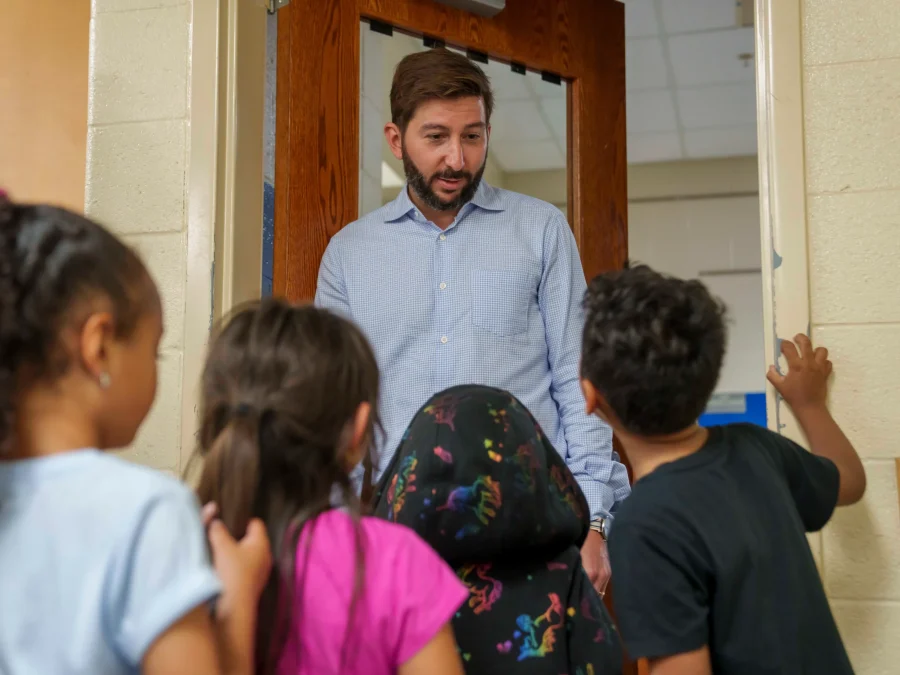
Excuse the sweat, Krause says on our way to a club visit.
Earlier, he’d been at the Baker Club at Hiatt Middle School, which has a mini-soccer pitch and, as a former college and semi-pro athlete, well, Krause couldn’t resist.
The kids didn’t expect much from him — probably because of the khakis and the button-down — but Krause trapped the ball and scored a goal from half court, he says.
Oh, snap, this guy knows ball, one of the kids yelled out.
“I love going to our clubs. Like I loved going to our stores when I was at Kum & Go,” says Krause, 39, who kept his employee “numbers” throughout his tenure with the company so he could hop on a register if needed — or just if he wanted to, which he often did.
“That’s where the magic happens.”
Reduced to concentrate, the Boys & Girls Clubs bridge the childcare gap between when school lets out and when the workday ends. During the academic year, those hours are 2:30 p.m. to 6:30 p.m. In the summer, they’re open all day, from about 7:30 a.m. to 5:30 p.m.
“The clubs allow parents to extend their hours or have employment altogether,” Krause says. “There are certain kids that if we were not an option for them, their parents would have to either work less or potentially pivot into working an overnight shift while their kids were sleeping.”
Or, of course, not work at all.
“Certainly if we weren’t here, there would be fewer people able to participate in the workforce and that would have an economic impact to the city,” Krause says.
Internal data at Boys & Girls Clubs puts an even finer point on the financial repercussions, asserting that every $1 invested in the organization generates $4.69 in economic and social benefits to Des Moines.
But since the Central Iowa chapter’s founding 60 years ago — when some of Des Moines’ highlighter prominent families (Burt, Meredith, Blank, Levitt) seeded the first site — the clubs have used their supervisory role as a roux, of sorts, into which they add life-enhancing programs.
Academically, more than 85% of club members are on track to complete their high school diplomas, nearly 10% higher than Des Moines Public Schools’ 2025 graduation rate, according to the organization.

And through homework help or spending extra time on difficult subjects with mentors, about 80% of member kids achieved mostly As and Bs last year.
Outside of schoolwork, clubs focus on health and fitness, character and leadership, and life and workforce readiness.
And after going through those programs, nearly 80% of club kids surveyed felt ready to manage their personal finances, and more than 90% reported they had an adult with whom they felt comfortable sharing problems and felt accepted as their fullest selves while at club.
“These are the kids who are graduating from Des Moines high schools and going into the job market or going on to university or community college or the trades,” Krause says, “and they’re better prepared for it because of Boys & Girls Clubs.”
Krause joined the Club’s board about nine years ago, when it undertook a $17 million capital campaign to expand and update current spaces as well as build three new facilities, including teens-only clubs that would allow students in higher grades to participate for longer.
That was a new phase of growth and resource allocation, Krause says. A point to pivot hard and ask what’s needed and what’s sustainable — similar in essence to what they are doing now.
“Raising children isn’t easy these days. And I understand all the challenges that our families face because they’ve talked with me about it,” says Jill Burnett-Requist, who’s been with the Des Moines Public Schools since 1996 and principal at Carver Elementary, which has a Boys & Girls Club on site, for more than a decade.
“The clubs have evolved obviously over that many years,” she says, “but what’s remained the same is the commitment to supporting kids in the community and looking at the community’s needs as a whole and trying to fill those gaps,” she says.
“I just know that if we’re all working together, we can support the future of our community — which is our kids.”
Travis LaCoss/The Register
What’s next for Boys & Girls Clubs? And for Tanner Krause?
Since starting in April as the interim leader — for which he isn’t drawing a salary — Krause has been meeting with headquarters staff, on-site personnel and club kids, the last of whom only deliver advice and criticism unvarnished, he says with a laugh.
He’s also spent a good portion of the first two months inventorying spend with members of the administration and familiarizing himself with the group’s stewardship of their partner’s dollars.
It is already a “lean organization,” he says, “but It’s really important that we manage every dollar we earn with great care.”
“We’re looking at a number of things to learn: How would this impact the quality of service we provide our kids if we didn’t do it? Or if we did it differently?”
For much of the past decade, the Boys & Girls Clubs operated in the black despite grants and contributions fluctuating. But in fiscal year 2024 and 2025, they’ve been $1,000,000 in the red, with expenses staying flat and revenue declining.
Krause was able to land some contributions that will bring a strong end to the fiscal year on June 30, he says, freeing leadership to be more focused on the future.
“The good news is, in times of uncertainty, community partners want to know that if they do give, that it’s going to an organization with a great reputation and a great ability to deliver efficiently to achieve its mission,” Krause says. “Thanks to decades of leadership, the Boys and Girls of Central Iowa is recognized as a safe and smart bet if you’re trying to be impactful with your philanthropic giving.”
A strategy guy at his core, Krause geeks out about “plans for success,” like the one home office staff is working on right now.
Thinking about where an organization could be in five years or 10 years, and then motivating a team to cultivate the skills, often within themselves, to achieve something that may seem really hard — now, that’s the really fun side of being a CEO, he says.
What he means, to use half a cliché, is that it’s the journey and the destination. Back to that motivating purpose: development that bends toward betterment, whether in people, society or, yes, companies. Development and betterment — both equally important.
Zach Boyden-Holmes/The Register
It’s enough to make you think he’s trying out for the job himself. But no, he says. Emphatically. His family is very happy in New York. He’s not moving back. And the CEO should be based in town.
So when they find that person, he’ll transition back to the board, which was the only one he stayed on when he moved east.
Then he’ll look for another opportunity. He’s been consulting since moving, but this experience has reminded him that he’s best when busy.
“I’m too young to retire,” he says. “I feel like I have too much to give to not engage at a leadership level.”
Nonprofit, for-profit, retail, branding, philanthropic, Krause is open to whatever, he says. “That purpose part just has to be there.”
But for now, Krause’s “purpose part” is clear. He’s helping more club kids find — and live — theirs.
Stay in the know with stories that matter — visit HolaAmericaNews.com for the latest news, culture, and community updates!
Facebook Comments