




By Hola Iowa
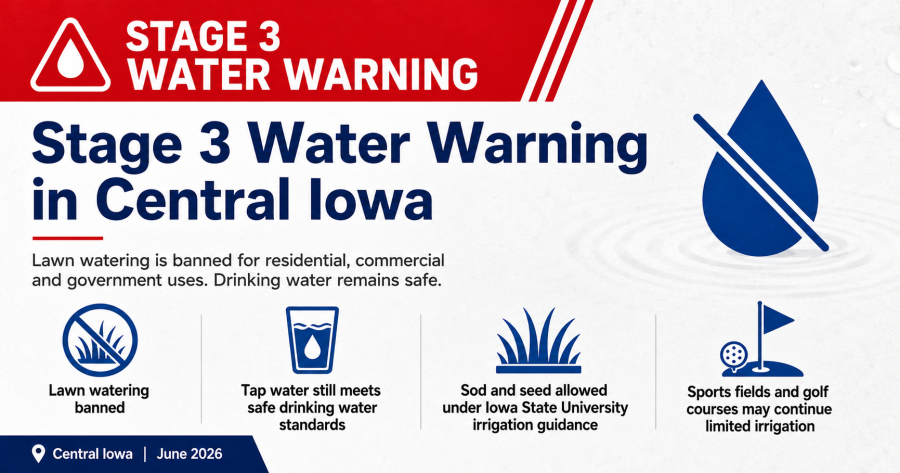
Central Iowa Water Works issued a Stage 3 Water Warning on June 8. The mandatory restriction applies to residential, business and government customers across several communities in the region.
Central Iowa Water Works issued a Stage 3 Water Warning and ordered a mandatory lawn watering ban across several Central Iowa communities beginning June 8, 2026. The restriction applies to residential, business and government customers within the regional water authority’s service area.

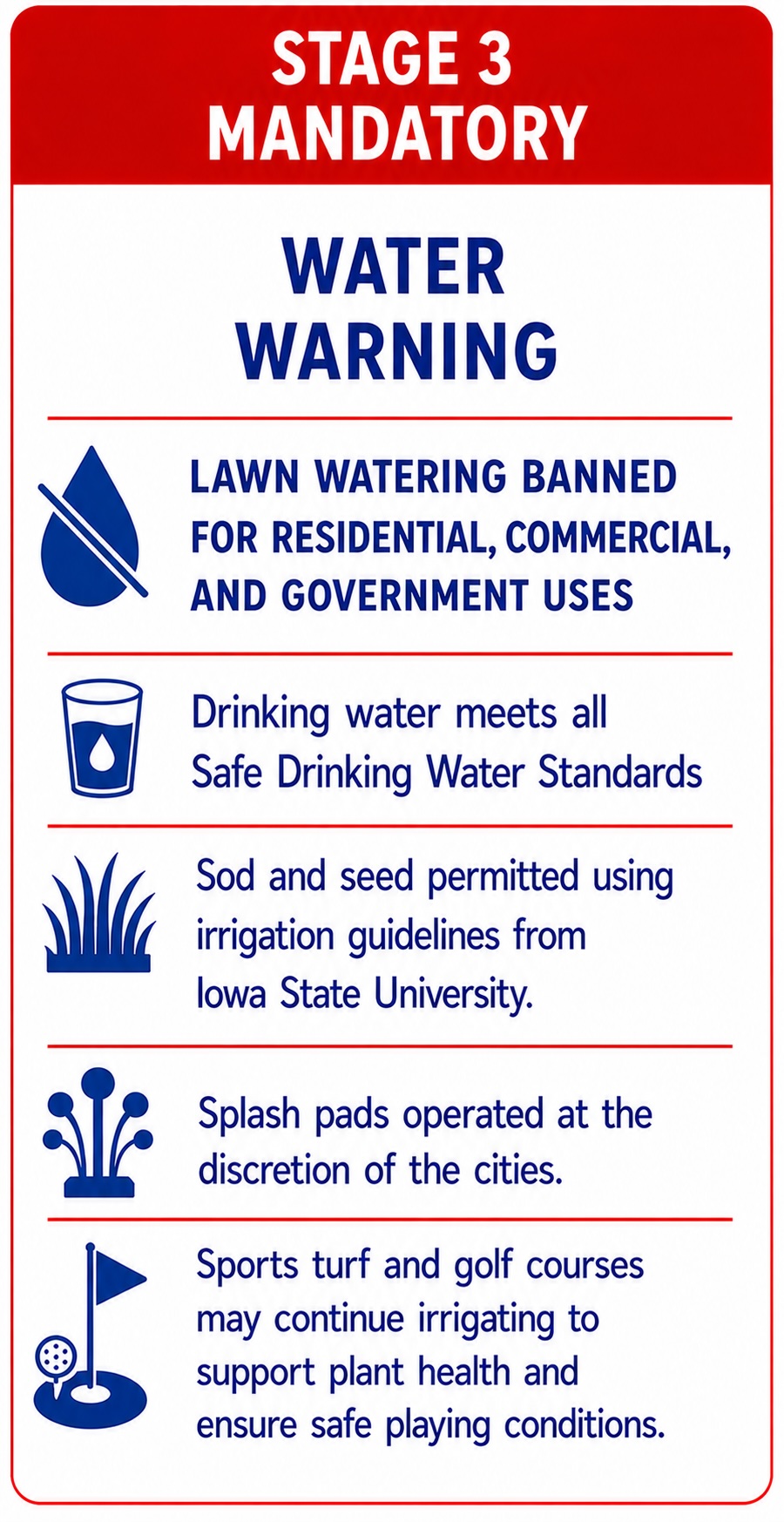
The ban is meant to reduce demand while water treatment facilities manage elevated nitrate levels in source waters. Central Iowa Water Works said drinking water remains safe and continues to meet state and federal standards, but the regional system is operating at the limits of its available treatment resources.
The regional water authority said it is using available resources, including the Nitrate Removal Facility, Maffitt Reservoir and Aquifer Storage and Recovery wells, known as ASR wells, to maintain drinking water service.

The alert affects more than 600,000 people in Central Iowa
Central Iowa Water Works, or CIWW, is the regional authority responsible for drinking water treatment, water system planning and wholesale water delivery across urban, suburban and rural parts of Central Iowa.

The authority was created in 2024 by 12 members representing cities, utilities and rural providers. Together, those members serve more than 600,000 Iowans and distribute nearly 20 billion gallons of water each year.
The communities and agencies affected by the alert include Ankeny, Clive, Johnston, Norwalk, Polk City, Waukee, Des Moines Water Works, Urbandale Water Utility, West Des Moines Water Works, Warren Water and portions of the Xenia Water District.
CIWW’s founding members also include Grimes, Warren and Xenia water districts. Local utilities, rural providers and city water departments remain the contact for new accounts, bill payment, water distribution and customer service.
Lawn watering is prohibited with limited exceptions
The Central Iowa watering ban took effect immediately across the CIWW service area.

Lawn watering is prohibited, except for newly installed sod or seed placed during the current growing season. In those cases, watering should be limited to the minimum amount needed for the sod or seed to become established.
Sports fields and golf courses may be irrigated only at the minimum level needed for safety and plant preservation. Decorative water features that do not recirculate water should be turned off.
CIWW also asked customers to immediately stop all unnecessary outdoor water use. The restriction applies to homes, businesses and government properties within the affected service area.
Read more: DART will cut routes in Des Moines but run buses more often
Indoor conservation is also encouraged during the alert
The Stage 3 Water Warning focuses on outdoor watering, but CIWW also asked customers to reduce indoor water use wherever possible.
The authority recommends running dishwashers and washing machines only with full loads. Customers are also urged to repair leaking faucets, fixtures and running toilets.
Other steps include turning off water while brushing teeth or shaving and delaying non-essential activities that use large amounts of water.
CIWW said reducing demand helps preserve treatment capacity while elevated nitrate levels continue in source waters.
Nitrates are affecting key regional water sources
Central Iowa Water Works said Central Iowa is seeing unusually high nitrate concentrations in three primary sources used to produce drinking water at the Fleur Drive water treatment plant: the Raccoon River, the Des Moines River and the Infiltration Gallery.
The Infiltration Gallery is a perforated pipeline under Water Works Park that collects and naturally filters water from the Raccoon River. When several source waters have high nitrate levels at the same time, the system has less flexibility to shift production to a lower-nitrate source.
CIWW said lawn watering is the largest discretionary use of water during the summer and can account for up to 40% of regional water demand. Temporarily suspending lawn watering reduces demand for treated water while the system continues to meet drinking water standards.
The authority said the ban is not caused by a lack of water in rivers or reservoirs. The challenge is treatment capacity: high nitrate concentrations limit how much water can be treated and delivered while meeting Safe Drinking Water Act requirements.
As of June 8, CIWW said the Raccoon River had measured nitrate concentrations above 10 milligrams per liter for 136 days, the Des Moines River for 117 days and the Infiltration Gallery for 86 days. The Nitrate Removal Facility has operated for approximately 95% of the year.
CIWW also said it has already used about 50% of the available water stored in Maffitt Reservoir, a reserve used to supplement supplies during periods of poor source water quality or drought.
Customers can check current restrictions through CIWW
Customers can review the Water Use Plan, current restrictions and frequently asked questions at CIWW.gov and through Central Iowa Water Works’ official Facebook and LinkedIn pages.
Questions about new accounts, bill payment, water distribution or customer service should be directed to the customer’s local utility, rural provider or city water department.
The Stage 3 Water Warning began June 8, 2026, and the mandatory lawn watering restrictions remain in effect immediately across the Central Iowa Water Works service area.
Stay in the know with stories that matter — visit HolaAmericaNews.com for the latest news, culture, and community updates!
Facebook Comments