
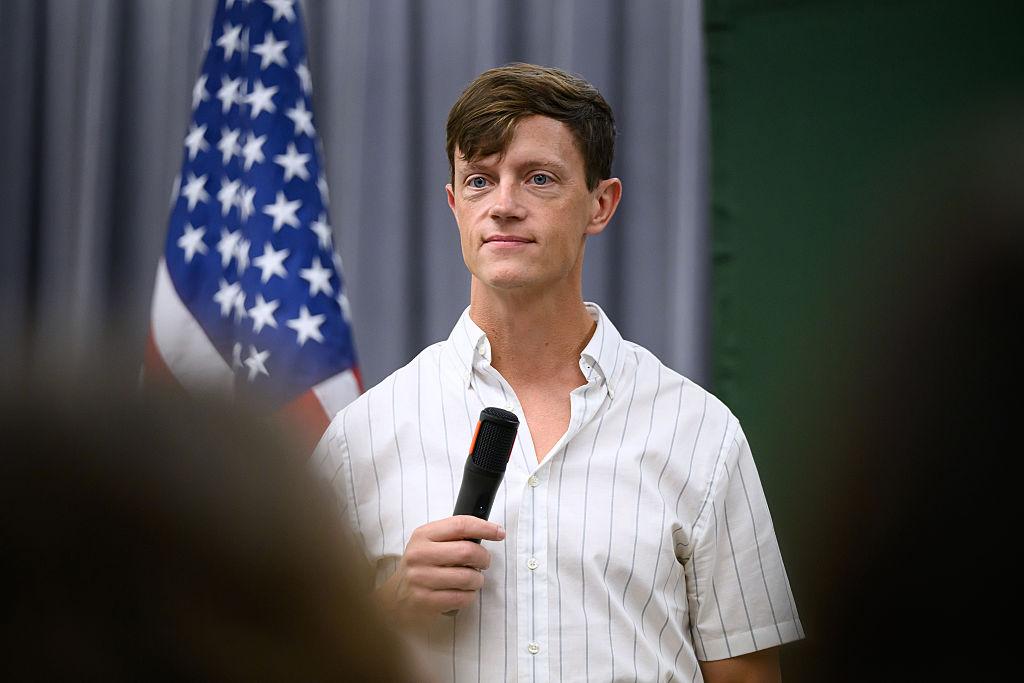



The two-term state auditor received 55.5% of the preliminary vote. His plans for education funding, Medicaid and household costs will face a Republican-controlled Legislature.
By Hola America News
Unofficial election results as of November 4, 2026, at 12:37 p.m. CT. Vote totals are subject to the official canvass and certification.

DES MOINES, Iowa — Democrat Rob Sand defeated Republican Zach Lahn in Iowa’s November 3 gubernatorial election, becoming the first Democrat elected governor of the state since 2006. The Associated Press called the race Tuesday night, ending Republican control of the governor’s office, which the party has held since 2011.
According to Associated Press vote totals reported Wednesday, Sand received 757,326 votes (55.5%), compared with 607,415 votes (44.5%) for Lahn. The figures remain unofficial and could change before certification.
Sand will succeed Republican Gov. Kim Reynolds, who chose not to seek another term. His election will create divided state government because Republicans retained control of both chambers of the Iowa Legislature.
Sand brings two terms as state auditor to the governor’s office
Sand, 44, was first elected Iowa state auditor in 2018 and won reelection in 2022. Following that election, he was the only Democrat holding statewide elected office in Iowa.
Before becoming auditor, Sand served as an assistant attorney general. His prosecutorial work included an investigation into a multistate lottery-rigging scheme involving manipulated jackpots.
As auditor, Sand focused on oversight of public spending and government accountability. His gubernatorial campaign emphasized those issues alongside cooperation across party lines.
His victory represents a political shift in Iowa, a state that President Donald Trump carried by more than 13 percentage points in the 2024 presidential election.
The last Democrat elected governor was Chet Culver, who won in 2006. Republican Terry Branstad defeated Culver in 2010 and took office the following January. Reynolds succeeded Branstad in 2017.
In his election-night remarks, Sand thanked Republican and independent voters who supported him. He also pledged to represent Iowans who voted for Lahn, according to Radio Iowa.
Sand proposes income limits and stronger oversight for Iowa’s ESA program
Education funding was one of the major differences between Sand and Lahn during the campaign.
Iowa’s Students First Education Savings Account (ESA) program provides state funding that eligible families can use for tuition and other approved expenses at accredited private schools. Reynolds signed the legislation establishing the program in January 2023.
Sand criticized the use of public funding for private school tuition while advocating greater investment in public schools. He proposed restoring income limits for ESA eligibility and requiring stronger accountability from participating private schools.
During the candidates’ final debate, Sand also argued that private schools receiving taxpayer funding should be required to admit eligible students, including those with disabilities.
Lahn defended universal income eligibility for the program. Both candidates supported stronger financial oversight of private schools receiving public funding, according to Iowa Public Radio’s coverage of their October 27 debate.
Sand’s victory does not change the ESA rules currently in effect. Iowa eliminated income-based eligibility restrictions beginning with the 2025–26 school year.
For 2026–27, the Iowa Department of Education lists a full-year ESA amount of $8,148 and a half-year amount of $4,074 per eligible student.
The current half-year application period remains open through November 15, 2026, at 11:59 p.m. Applicants must meet the program’s existing residency, enrollment and documentation requirements.
Related: Iowa ESA $4,074: Apply by Nov. 15, 2026
Restoring income limits or changing other eligibility requirements established in state law would require legislative action. The Students First Act remains in effect.
Sand wants to change Iowa’s privately managed Medicaid system
Sand has proposed ending Iowa’s reliance on private managed-care organizations to administer Medicaid coverage.
Most Iowa Medicaid members currently receive coverage through Iowa Health Link, which contracts with managed-care organizations. Some members instead receive services through a fee-for-service arrangement.
During the campaign, Sand argued that delayed reimbursements and denied claims by private insurers have contributed to difficulties for health care providers, including mental health professionals.
Lahn supported maintaining private Medicaid management while strengthening oversight of provider payments and claim decisions.
Both candidates acknowledged that Iowa needs additional mental health treatment capacity. They also discussed Medicaid work requirements during their final debate.
Sand said his administration would comply with federal law while seeking to prevent eligible Medicaid recipients from losing coverage because of complicated reporting requirements.
A change to Iowa’s Medicaid administration would involve existing contracts and applicable state and federal requirements. Federal approval processes could also be necessary, depending on the approach pursued.
The election does not immediately change Medicaid benefits, coverage or eligibility. Sand has not yet implemented a replacement for the current managed-care system.
Sand proposes utility fee limits, housing assistance and public school meals
Sand also campaigned on reducing expenses for Iowa households.
His August 31 affordability proposal included measures addressing energy costs, housing, health care and education.
Among his proposals were:
- Utility bills: Limiting certain service or meter fees that customers pay regardless of their energy consumption.
- Housing: Reducing regulatory barriers to home construction and making down payment assistance interest-free for first-time buyers.
- Health care: Pursuing lower prescription drug costs and additional protections against medical debt.
- Public education: Expanding access to prekindergarten and providing universal school meals for Iowa public school students.
Those measures are campaign proposals, rather than benefits or statewide policy changes already approved.
Implementing proposals that require additional appropriations or changes to state law would depend on legislative action. Specific funding amounts, eligibility requirements and implementation dates have not been established for these proposals.
Republicans retain control of the Iowa House and Senate
Sand will take office in January 2027 with Republicans maintaining majorities in both chambers of the Legislature.
As governor, he will be able to recommend a state budget, establish executive-branch priorities within existing law and work with state agencies. However, lawmakers will control whether many of his proposed statutory and spending changes advance.
His plans for ESA eligibility, education funding and household assistance will therefore depend partly on negotiations with Republican legislators.
The next Iowa legislative session is scheduled to begin January 11, 2027, according to the Iowa Legislature’s official timetable.
Before then, the state must complete its election canvass. The Iowa Secretary of State’s 2026 election calendar establishes November 30 as the deadline for completing the state canvass.
Related: 2026 Election Results: Six Historic Firsts Across the U.S.
Stay in the know with stories that matter — visit HolaAmericaNews.com for the latest news, culture and community updates!
Facebook Comments
