

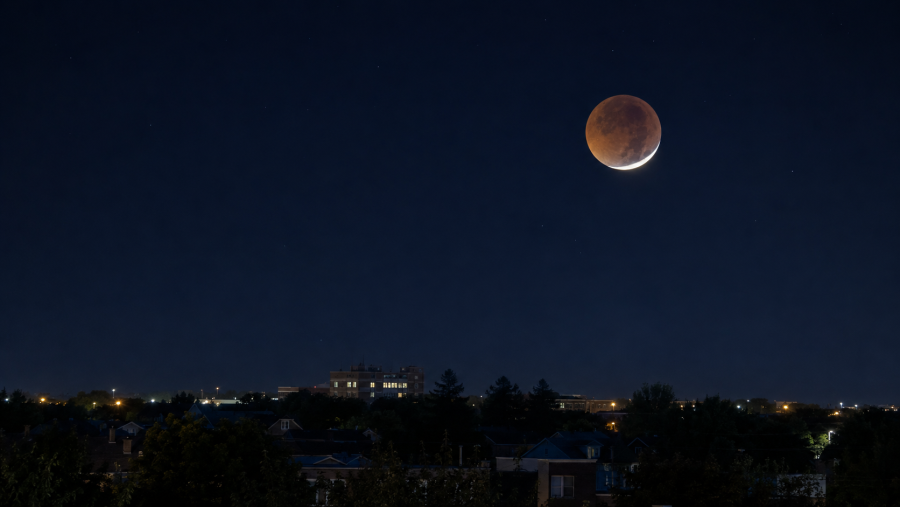



The next lunar eclipse visible from Iowa and Illinois will be Feb. 20, 2027, followed by another penumbral eclipse in August and a partial eclipse in January 2028.
Updated Sept. 24, 2026.
By Hola America News

IOWA AND ILLINOIS — Skywatchers in Iowa and Illinois will have several opportunities to see lunar eclipses over the next two years, beginning with a penumbral eclipse on Feb. 20, 2027.
The February event will be subtle, with the Moon passing through the lighter outer portion of Earth’s shadow. A second penumbral eclipse will occur Aug. 17, 2027, followed by a partial lunar eclipse on Jan. 11–12, 2028.
Unlike solar eclipses, lunar eclipses are safe to watch without special glasses. They can also be seen without a telescope whenever the Moon is above the horizon and clouds do not block the view.

The next lunar eclipse in Iowa and Illinois is Feb. 20, 2027
The next lunar eclipse visible from Iowa and Illinois will occur Saturday, Feb. 20, 2027.

It will be a penumbral lunar eclipse, meaning the Moon will pass through the lighter outer portion of Earth’s shadow rather than the darker central umbra.
Much of the eclipse will begin before moonrise in Iowa and Illinois, so viewers will see only the later portion of the event.

In Des Moines, the Moon will rise at about 5:54 p.m. Central Time. The eclipse will remain visible until approximately 7:13 p.m.
In Moline and the Quad Cities, the Moon will rise slightly earlier. The visible portion begins around 5:41 p.m., with the Moon still low in the eastern sky, and ends at about 7:13 p.m.

Because this is a penumbral eclipse, viewers should expect a relatively subtle darkening rather than the dramatic red or copper appearance associated with a deep partial or total lunar eclipse.
Another penumbral lunar eclipse arrives Aug. 17, 2027
Iowa and Illinois will get a second penumbral eclipse during the early morning hours of Aug. 17, 2027.
Unlike the February eclipse, the entire event will occur while the Moon is above the horizon across much of both states.
The schedule is the same in Des Moines and the Quad Cities:
| Phase | Central Time |
|---|---|
| Penumbral eclipse begins | 12:24 a.m. |
| Maximum eclipse | 2:13 a.m. |
| Penumbral eclipse ends | 4:03 a.m. |
The change in brightness may still be difficult to notice during the early stages. The effect becomes easier to detect closer to maximum eclipse, particularly when comparing the Moon’s appearance over time.
A partial lunar eclipse will be visible Jan. 11–12, 2028
The next partial lunar eclipse visible from both Iowa and Illinois will occur during the night of Jan. 11–12, 2028.
That event will produce a more obvious bite-like shadow on the Moon because part of the lunar surface will enter Earth’s darker umbra.
For Iowa and Illinois, the main phases occur at the same Central Standard Time:
| Phase | Central Time |
|---|---|
| Penumbral eclipse begins | 8:07 p.m. |
| Partial eclipse begins | 9:45 p.m. |
| Maximum eclipse | 10:13 p.m. |
| Partial eclipse ends | 10:41 p.m. |
| Penumbral eclipse ends | 12:18 a.m. |
The 2028 eclipse will be partial but relatively shallow. It will not cover nearly as much of the Moon as the deep partial eclipse visible across the Midwest in August 2026.
The August 2026 eclipse covered 96.3% of the Moon
One of the most dramatic recent lunar eclipses visible from the Midwest occurred on Aug. 27–28, 2026.
At maximum eclipse, 96.3% of the Moon’s visible disk was inside Earth’s dark central shadow, or umbra.
The partial phase began at 9:34 p.m. Central Daylight Time, reached maximum at 11:13 p.m. and ended at 12:52 a.m.
A narrow bright section remained outside the umbra, which is why the event remained a partial eclipse rather than becoming total.
The contrast between the brightly illuminated edge and the darkened portion of the Moon made the eclipse resemble a total lunar eclipse near maximum.
NASA’s visualization of the Aug. 27–28, 2026 lunar eclipse shows the Moon’s path through Earth’s shadow.
What is the difference between total, partial and penumbral lunar eclipses?
A lunar eclipse happens when the Sun, Earth and Moon align closely enough for the Moon to move through Earth’s shadow.
The appearance depends on which part of the shadow the Moon enters:
- Total lunar eclipse: the entire Moon moves into Earth’s dark central shadow, called the umbra.
- Partial lunar eclipse: only part of the Moon enters the umbra.
- Penumbral lunar eclipse: the Moon passes through Earth’s lighter outer shadow, producing a more subtle dimming.
Total and deep partial eclipses can turn parts of the Moon orange, red or copper.
That color occurs because sunlight passes through Earth’s atmosphere before reaching the Moon. More blue light is scattered, while red and orange wavelengths continue through the atmosphere and illuminate the lunar surface.
Lunar eclipses are safe to watch without eclipse glasses
No special eye protection is required to watch a lunar eclipse.
Unlike a solar eclipse, looking directly at the Moon during a lunar eclipse does not damage the eyes.
Viewers do not need eclipse glasses or solar filters.
Binoculars can make color and shadow changes easier to see, while a telescope can provide a closer look at the edge of Earth’s shadow, but neither is required.
Where to watch a lunar eclipse in Iowa and Illinois
A lunar eclipse does not require a specialized observing site, but a few conditions can improve the view.
Choose a location with a clear view of the Moon and as little artificial lighting as practical. Open parks, rural roads, recreation areas and other places away from bright streetlights can provide better contrast.
For eclipses occurring near moonrise, such as the February 2027 event, an unobstructed view toward the eastern horizon will be especially important.
Cloud cover can determine whether an eclipse is visible at all. Local forecasts become useful only as the event approaches, so viewers should check conditions shortly before heading outside.
Other sky events are visible from Iowa and Illinois throughout the year
Lunar eclipses are only part of the astronomy calendar for Iowa and Illinois.
Meteor showers, conjunctions, bright planets and unusual full moons can also be visible without specialized equipment.
Related: Perseid meteor shower in Iowa: best time to watch
Major events can vary in visibility from one year to the next, so local moonrise times, weather and the observer’s location remain important even when an eclipse is visible across a large region.
Stay in the know with stories that matter — visit HolaAmericaNews.com for the latest news, culture and community updates!
Facebook Comments