

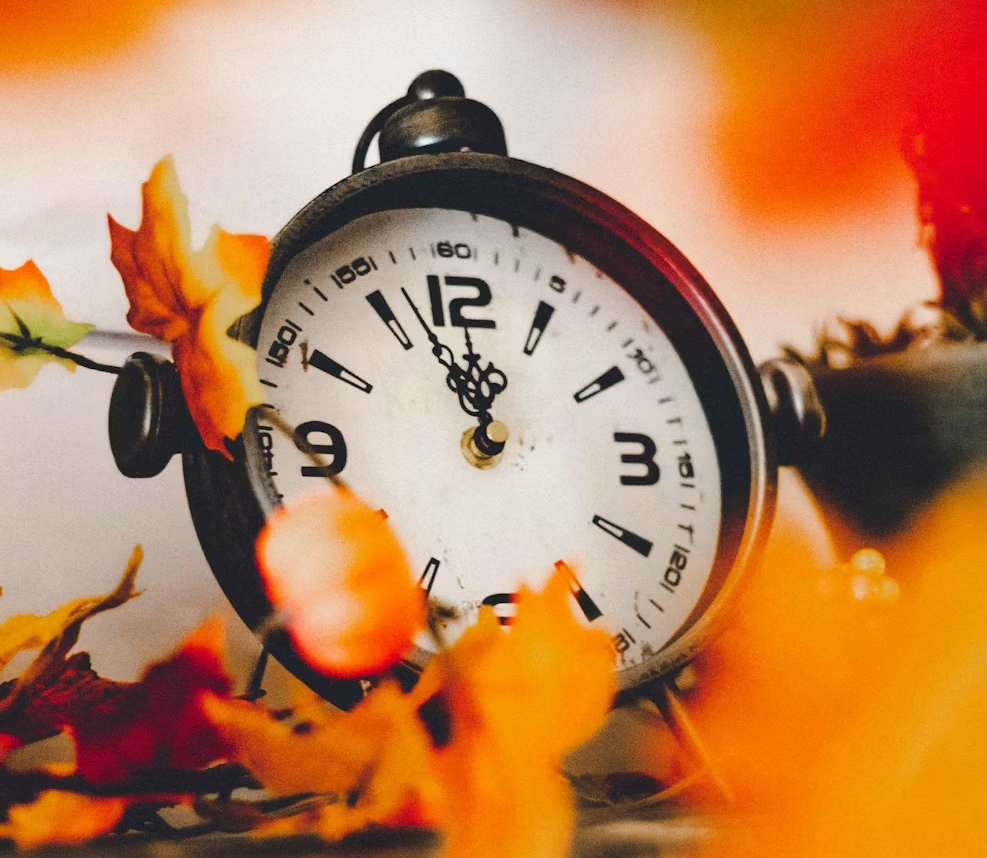



Clocks will move back one hour at 2 a.m. Sunday, Nov. 1, across Iowa, Illinois and the Quad Cities. The change marks the end of daylight saving time for 2026.
Published Oct. 2, 2026. Updated Oct. 19, 2026.
MIDWEST — Daylight saving time ends Sunday, Nov. 1, 2026, in Iowa, Illinois and most of the United States. At 2 a.m. local time, clocks will fall back one hour to 1 a.m., marking the return to standard time.

The change applies to Des Moines, Cedar Rapids, Iowa City, Davenport, Bettendorf, Moline, Rock Island and other communities across both states. Central Daylight Time (CDT) will become Central Standard Time (CST), and the hour between 1 and 2 a.m. will occur twice.
Most U.S. states make the seasonal change. Hawaii and most of Arizona do not observe daylight saving time, while the Navajo Nation in Arizona does. American Samoa, Guam, the Northern Mariana Islands, Puerto Rico and the U.S. Virgin Islands also remain on standard time year-round.

Clocks move back one hour at 2 a.m. Nov. 1
The November change is the “fall back” part of the familiar “spring forward, fall back” reminder. At 2 a.m. Sunday, Nov. 1, clocks return to 1 a.m.
- Date: Sunday, Nov. 1, 2026
- Time: 2 a.m. local daylight time
- Change: Clocks move back one hour to 1 a.m.
- In Iowa and Illinois: CDT changes to CST
The official daylight saving time schedule from the National Institute of Standards and Technology (NIST) confirms that the 2026 daylight saving period runs from March 8 through Nov. 1 in U.S. locations that observe the change.

Iowa and Illinois return to Central Standard Time
Iowa and Illinois observe daylight saving time, so communities across both states will make the Nov. 1 change. That includes Des Moines, Cedar Rapids, Iowa City, Davenport, Bettendorf, Moline, East Moline, Rock Island and Silvis.
Before the change, those communities are on Central Daylight Time, or CDT, which is five hours behind Coordinated Universal Time. After the clocks move back, they return to Central Standard Time, or CST, which is six hours behind UTC.

Hawaii and most of Arizona do not change their clocks
The Nov. 1 switch does not apply everywhere in the United States. Hawaii and most of Arizona do not observe daylight saving time. The Navajo Nation, which extends into Arizona, does observe it.
The U.S. territories of American Samoa, Guam, the Northern Mariana Islands, Puerto Rico and the U.S. Virgin Islands also do not make the seasonal clock change.

Phones and computers usually update automatically
Many smartphones and computers update automatically when their date and time settings are set to automatic. NIST notes that computer and cell phone clocks commonly make the change without manual adjustment.
Wall clocks, watches, ovens, microwaves and some vehicle clocks may still need to be changed manually. Older electronic clocks with preprogrammed daylight saving settings can also follow outdated schedules.
International time differences can shift after Nov. 1
The U.S. time change can temporarily alter the time difference with cities in other countries. Not every country observes daylight saving time, and countries that do use seasonal changes do not necessarily switch on the same dates as the United States.
Across Latin America, time-change rules vary by country and region. As a result, the time difference between the Midwest and relatives, businesses or destinations abroad may change by an hour even though the other location did not change its clocks that day.
Daylight saving time returns March 14, 2027
Under the current U.S. schedule, daylight saving time begins on the second Sunday in March and ends on the first Sunday in November.
That places the next spring change on Sunday, March 14, 2027. At 2 a.m. local standard time, participating areas will move their clocks forward one hour to 3 a.m.
The official term is daylight saving time, without an “s” after “saving,” although “daylight savings time” is also common in everyday conversation and searches.
For 2026, daylight saving time remains in effect through 2 a.m. local time Sunday, Nov. 1, when participating U.S. locations return to standard time.
Stay in the know with stories that matter — visit HolaAmericaNews.com for the latest news, culture and community updates!
Facebook Comments