



By William Morris, Des Moines Register
As Americans have witnessed alarming scenes of confrontations between protestors and U.S. Immigration and Customs Enforcement agents in Minneapolis, Iowa Attorney General Brenna Bird is urging federal courts not to restrain federal immigration authorities’ actions.

Bird, joined by 20 other Republican attorneys general, filed a friend-of-the-court brief Jan. 21 objecting to a federal judge’s order finding that ICE and other federal officials were likely violating Minnesotans’ constitutional rights. The court ordered agents to desist pepper-spraying nonviolent observers and using other controversial tactics.
The brief was filed before officers on Saturday, Jan. 24, shot and killed Alex Pretti, a nurse with the Department of Veterans Affairs, the second fatal shooting since federal enforcement agencies descended en masse on the Twin Cities in December.
In her filing, Bird criticized the “not-mostly peaceful protesting” and argued the district court had improperly treated the case before it as a class-action on behalf of all protestors. In an unusual move, Bird’s office did not announce the filing with a news release.
A federal appeals court has since temporarily stayed the lower judge’s order without explanation, allowing ICE to continue its operation without changes.

What is ICE doing in Minnesota?
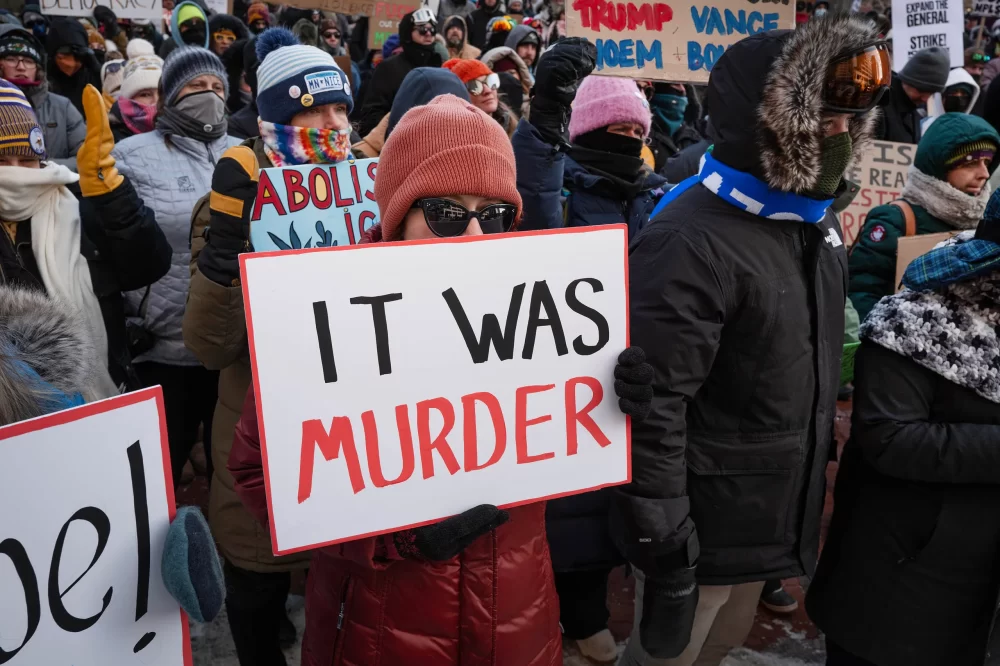
Operation Metro Surge, ICE and other federal agencies launched in early December, has sent more than 3,000 agents to the Twin Cities to engage in immigration enforcement. Observers have accused officials of widespread racial profiling, including of U.S. citizens, illegitimately arresting and using tear gas and other forms of force against nonviolent witnesses and demonstrators, and other abuses.
The surge has elicited widespread opposition in Minnesota, including major protests and community efforts to track and monitor ICE activities, shield schools and other locations and support immigrants and other residents who have gone into hiding.
ICE has reported making more than 3,000 arrests since December and blamed local officials for the growing unrest. On Jan. 19, U.S. Department of Homeland Security Secretary Kristi Noem characterized arrestees as “criminal illegal aliens who were killing Americans, hurting children and reigning terror in Minneapolis because Tim Walz and Jacob Frey (Minnesota’s governor and Minneapolis’ mayor) refuse to protect their own people and instead protect criminals.”
Federal officials have shot three people in Minnesota, two of them fatally: Renée Good, a 37-year-old citizen shot in her car on Jan. 7, and Pretti, also 37, another citizen shot Saturday after intervening in a dispute in which an officer had shoved a woman to the ground. Federal officials have accused both Good and Pretti, who was carrying a loaded gun, of attempting or planning to kill officers, though news media analysis of bystander videos of the shootings have concluded they do not support those contentions.
Judge restrains ICE; appeals court pauses order
Bird’s filing came in a lawsuit brought by six protestors who accused federal agents of violating their rights, including by tackling and arresting noninterfering observers, discrimination based on race and national origin, and illegally stopping and arresting people following agents in their vehicles. The plaintiffs sought to bring a class-action claim on behalf of all Minnesotans shadowing ICE activities, and asked the court for an injunction against these and other ICE tactics.
U.S. District Judge Katherine Menendez granted their request in part on Jan. 16. In her 83-page order, Menendez analyzed each plaintiff’s account, including relevant video footage, and concluded that the plaintiffs had shown “a likelihood of success on the merits of their claims” that officials had violated their constitutional rights.
“Defendants do not explain why it is necessary for them to arrest and use force against peaceful observers, like the named Plaintiffs and similarly situated nonviolent protesters, to curb other violence or attempts to forcibly obstruct their operations,” Menendez wrote. “Nor do Defendants explain how the public interest is served by officers stopping law-abiding motorists without reasonable, particularized suspicion of criminal wrongdoing.”
The judge enjoined federal officials from arresting, retaliating or using pepper-spray and other chemicals and munitions against, or conducting traffic stops of, “persons who are engaging in peaceful and unobstructive protest activity.”
The Department of Homeland Security appealed Menendez’s ruling, and on Jan. 21, a federal appeals court temporarily stayed her order pending further consideration of the government’s arguments. The same day, Bird and her coalition of 20 other attorneys general filed their brief supporting the government’s appeal.
Bird’s filing decries ‘disruptive protests and disorder’
Bird’s brief primarily focuses on two technical legal issues: whether the district court conducted the proper analysis before treating the case as a class action, and whether it should have required the plaintiffs to post a bond before granting an injunction. But she also makes clear her broader disagreement with the plaintiffs’ goals and positions.
“Like illegal immigrants entering our country, disruptive protests and disorder do not stay contained to one city or state,” she wrote. “… Responding to federal enforcement, protesters have taken increasingly aggressive tactics to interfere with those federal law enforcement activities. Protesters are blockading buildings, blocking roads, and obstructing church services.”
She goes on to argue that the First Amendment does not protect impeding law enforcement, and accuses the district court of entering an “improper” order “to protect this not-mostly peaceful protesting.”
Asked about her brief, Bird’s office voiced support for ICE and its efforts in the Twin Cities.
“Federal law enforcement efforts in Minnesota and across the country are focused on arresting illegal immigrants who have committed crimes,” she said in a statement. “As attorney general, I support those ongoing efforts.”
She added, “I am deeply saddened by the loss of human life, and also by violence against law enforcement officers in the line of duty.”
Bird’s statement did not address questions from the Des Moines Register about whether she believes ICE is respecting the constitutional rights of Minnesotans and about her positions on the Pretti and Good shootings and federal investigations.
Bird uncharacteristically quiet about filing
The filing is a continuation of Bird’s efforts to weigh in on a wide range of political and cultural disputes, including more than 150 multistate lawsuits, amicus briefs and official letters sent since taking office in 2023. Unlike the vast majority of those efforts, though, Bird did not issue a news release about last week’s amicus brief.
The only prior times the Register is aware of Bird having engaged in multistate action without publicizing that fact came in 2023, where she advocated restricting the common abortion medication mifepristone through an amicus filing in a Texas lawsuit and joining Missouri and other states in a letter to major pharmacy providers threatening legal consequences for providing the drug by mail order.
Stay in the know with stories that matter — visit HolaAmericaNews.com for the latest news, culture, and community updates!
Facebook Comments