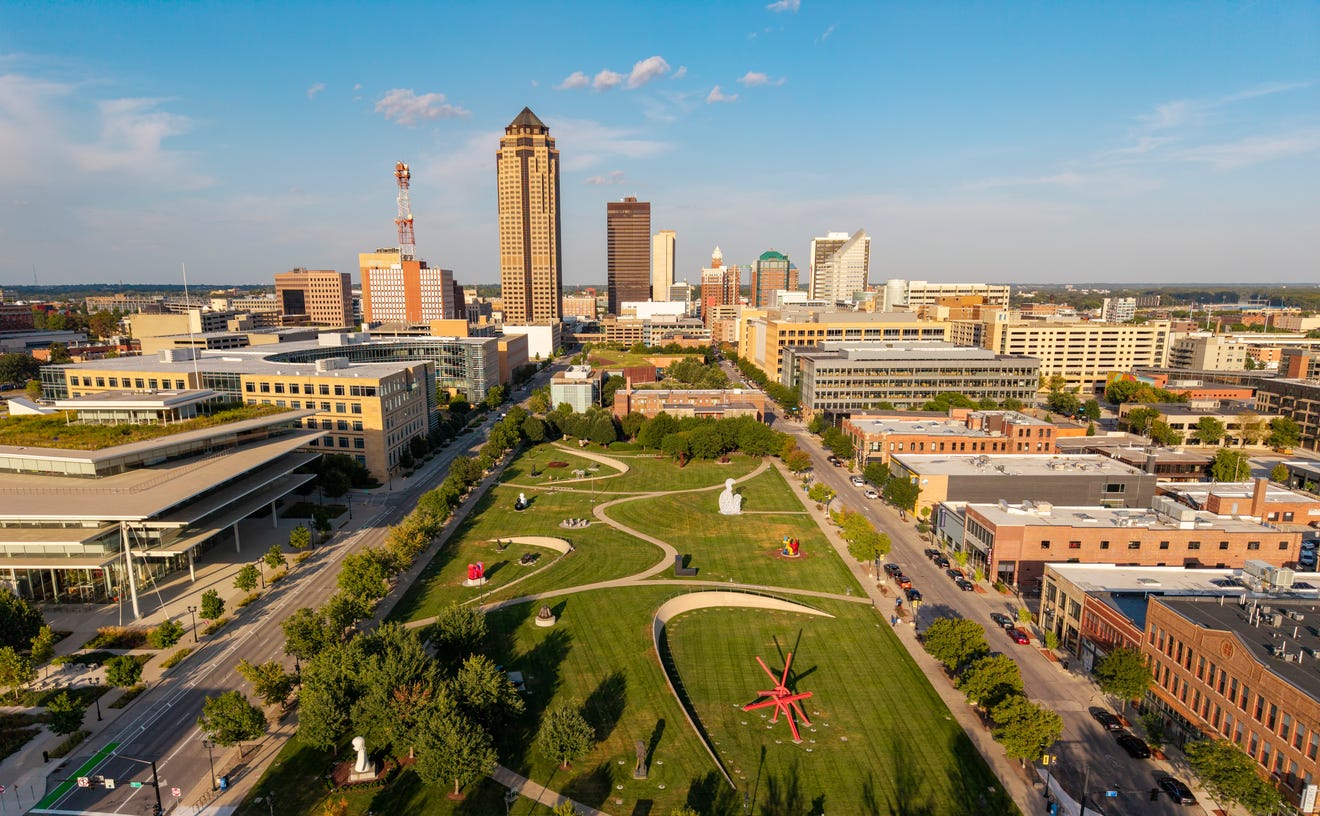

Will the Des Moines metro hit 1 million residents soon? It depends on how you measure it.

0
245

By Philip Joens, Des Moines Register

When will the Des Moines metro reach 1 million residents?

Advertisements

At the Greater Des Moines Partnership’s Regional Summit in September, CEO Tiffany Tauscheck pointed to a 10-county region of central Iowa that she said has a combined population of about 940,000 people, and that an increase to 1 million is in sight.

“Getting to that 1 million population mark is significant because once we reach 1 million, we are instantly eligible for all kinds of additional large economic development projects,” Tauscheck said.

But the area Tauscheck cited ― the Des Moines-Ames-West Des Moines combined statistical area ― extends well beyond the six counties in the federal government’s definition of the Des Moines metro. Hitting the 1 million mark in the metro category could take decades, and that’s if growth remains strong and steady.

How is central Iowa’s population measured?

Metro areas are the standard measure of an urbanized region’s size, and are the basis for all sorts of government policy and funding decisions and as well as for businesses deciding where to invest and expand. To designate a metro area, the U.S. Office of Management and Budget, which defines the metro areas used by the U.S. Census Bureau, starts with identifying an urban core city with a population of at least 50,000. In central Iowa, that is Des Moines, Iowa’s largest city, with a population 213,096 in 2024, and its home, Polk County, population 516,185.

Advertisements

The government then looks at measures of economic and social integration of other counties to that core. Those include the immediately adjacent counties containing the most population. For the current Des Moines metro, those are Dallas, with an estimated 2025 population of 116,984, and Warren, which had an estimated 56,343 residents in 2024. Together, those three counties account for about 90% of the metro’s population.

Beyond those counties, the agency then looks to other adjacent counties, gauging the proportion of their residents who commute to one of the larger counties for work and the degree to which those counties are urbanized and socially tied. Those factors are measured by statistics such as population density and the number of phone calls originating in the outlying counties that are made to numbers in the center of the metro.

Advertisements

The boundaries of metro areas can change over time. When the formal definition of metropolitan areas began in 1950, the Des Moines metro consisted of Des Moines and surrounding Polk County. The federal government added Warren County, then the region’s second-largest county, in 1973; Dallas County, which soon surpassed Warren in population, in 1983; Guthrie and Madison counties in 2003; and Jasper County in 2018.

Is a 1 million-population Des Moines metro area in sight?

Back in 1950, the original, standardized list of metros published by the census bureau listed 168, with Des Moines ranking just above the middle for population at 84th. It was slightly smaller than the Quad Cities in those days. But its growth has accelerated in almost every decade since, and it now ranks 82nd among 387 U.S. metropolitan areas, placing it among the top one-quarter in size.

Advertisements

The six-county metro ― Polk, Dallas, Warren, Jasper, Madison and Guthrie ― had an estimated population of 753,913 in 2024, up 6.3% from 709,517 in the 2020 census count. In numeric terms, it added 44,396 residents, or about 11,099 per year. If the metro continues to add residents at that annual total, it would reach 1 million sometime in the mid 2040s. That’s consistent with a 2016 estimate by the American City Business Journals.

The metro could get there faster if it continues to add counties. The combined statistical area for Des Moines that Tauscheck cited includes Boone County, which had an estimated 26,729 residents in 2024; Story County, home of Ames, which had an estimated population of 102,498 in 2024; Marion County, home of Pella and Knoxville, with an estimated population of 33,770 in 2023; and Mahaska County, home of Oskaloosa, with an estimated 21,874 residents in 2023.

Advertisements

Add their total populations to the Des Moines metro’s, and with continued growth, the region would achieve a population of 1 million on a timeline somewhat closer to the Partnership’s. But the definition of CSAs is based on looser ties than those used for metros ― primarily, whether at least 15% of residents in the outer counties commute toward the core urban area. For more than half of metro areas, there is no defined CSA, which makes them less useful for comparative purposes and planning.

CSAs can help forecast which counties may be added to a metro. But there’s no indication that another metro Des Moines expansion with, say, the addition of Story County, is coming anytime soon. Fast-growing Ankeny in northern Polk County is pushing toward the small cities like Slater and Huxley on Story County’s southern tier, which have seen their own suburban development boom. But there’s still a lot of rural territory between them.

Beyond that, James Chung, president of Reach Advisors, a Boston-based finance analytics firm, cautioned members of the Partnership at the September summit that the metro can’t count on sustaining its current growth indefinitely.

The Des Moines Register in 2024 reported that the metro’s financial sector, long the biggest driver of its growth, had been losing jobs since 2017. And since 2020, Chung said, the rate of the metro’s growth has slowed while other comparable Midwestern cities have seen theirs accelerate. In addition, the population of core city Des Moines has seen a slow slippage for the first time in decades.

“We’re at this cusp period… where the Des Moines economy is seeing a little bit of softening that others aren’t,” Chung said.

What would it mean to hit 1 million?

If and when the Des Moines metro reaches 1 million population, will it reap economic benefits, as Partnership CEO Tauscheck suggests? Or would it simply be a point of pride?

The experience of Des Moines’ nearest major metro neighbor, Omaha, about two hours west, could be indicative.

Metro Omaha celebrated hitting the 1 million mark when the census released its latest estimates earlier this year, showing it had reached a population of 1,001,010 in 2024.

Jeff Beals, founder of the Grow Omaha radio show and news website and a commercial real estate veteran, said reaching the population landmark was more than just symbolic.

He pointed to studies ranking metro areas across the country. Some only consider the 55 metros with 1 million or more people. Omaha now makes that cut; Des Moines doesn’t.

“It puts you on a different list,” Beals said. “Often when site-selection consultants or in-house corporate real estate people for major retail, restaurant or entertainment businesses are looking for sites, a lot of time they’ll draw a line under the last metropolitan area that has a million in population.”

Tauscheck seconded that recently as she toured the newly opened MidAmerican Energy Two Rivers Park on the east bank of the Des Moines River. The park features a cantilevered viewing platform providing a spectacular view of the downtown Des Moines skyline, where construction of 515 Walnut, a 33-story apartment development, will soon add another skyscraper.

“Site selectors, they look for reasons to rule out communities,” Tauscheck said. “When you’re not at a million population you instantly don’t meet the threshold to be eligible to for some of the economic development projects.”

“They will simply not locate in a smaller than a million,” said Des Moines City Manager Scott Sanders, who also was on the tour. “They’re going to have zero interest in a smaller community because they won’t be able to get the workforce, or they’ll have to transfer too much.”

For now, Des Moines’ economic leaders, trying to attract new companies to the area, have to show that its labor force is as strong as in competing cities, Tauscheck said, and that it already offers many of the attractions of some more populous areas.

“It is an industry standard,” Tauscheck said of the million-resident threshold. “So it’s our job to make sure that we’re informing the site selectors of all these great amenities.”

It’s too early to tell how hitting 1 million residents will change Omaha, Beals said. Retailers are expanding in the Omaha area, but he said he is unsure if it’s related to passing the 1 million threshold.

But he said he’s confident it will make difference in the long run, and that if the Des Moines metro eventually joins the 1 million club, “I think you’ll see more national businesses, whether they be entertainment, retail, restaurant, hospitality, major branch offices of companies. You show up on the radar of more of those.”

Facebook Comments

Advertisements