



- Iowa Governor Kim Reynolds resists calls for regulation of industrial agriculture despite water quality concerns and a lawn-watering ban in Central Iowa.
- Protesters gathered outside an event she was attending, demanding action on agricultural pollution and linking it to high cancer rates in the state.
- Reynolds defended farmers, and said they are already implementing conservation practices.
As the Des Moines metro labors through its first-ever lawn-watering ban, Gov. Kim Reynolds underscored her support for voluntary conservation practices, insisting “regulation is hardly ever the answer” for Iowa’s dangerous nitrate levels in its drinking water.
Asked about a recently released Polk County water-quality report that largely blamed agriculture runoff for high nitrate levels, Reynolds said Thursday, June 10, that it would be best to leave conservation measures to farmers.

Lily Smith/The Register
The report said nitrate levels in central Iowa are among the highest in the U.S. and routinely exceed the health-based drinking water standard, a study finds
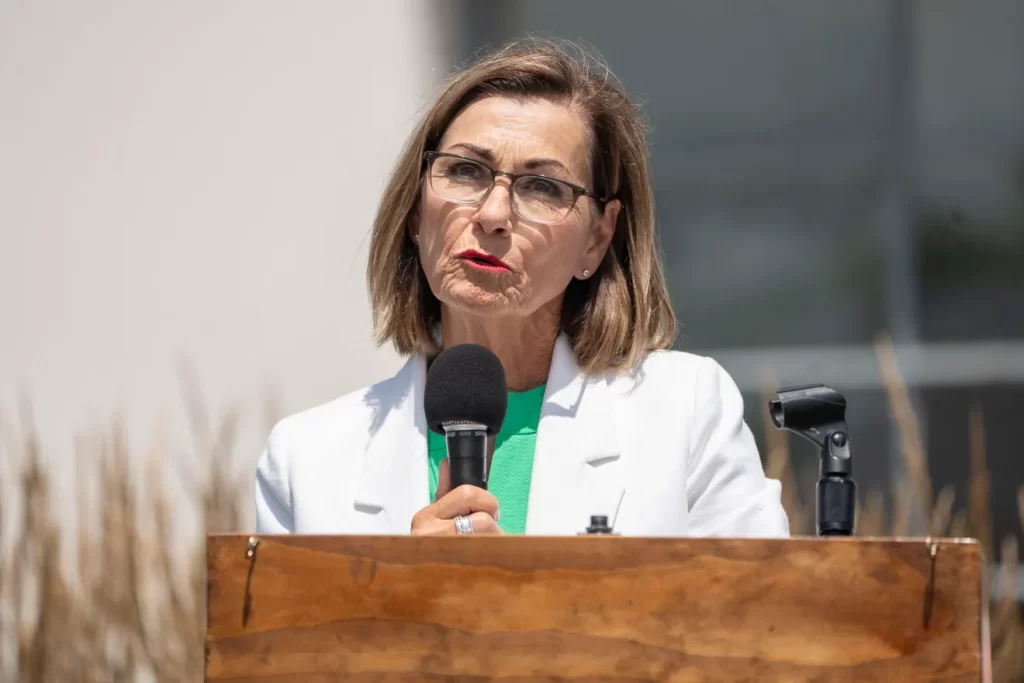
Regulation “is a killer in most instances — it takes out innovation,” Reynolds said as she joined Italian-American Cultural Center of Iowa leaders at a groundbreaking ceremony at the Butler Mansion in Des Moines. “I can’t control Mother Nature. They can’t control Mother Nature. So, that’s just a component that they have to work with. But mark my word: They’re working every single day to implement conservation practices, because they know it benefits everybody.”

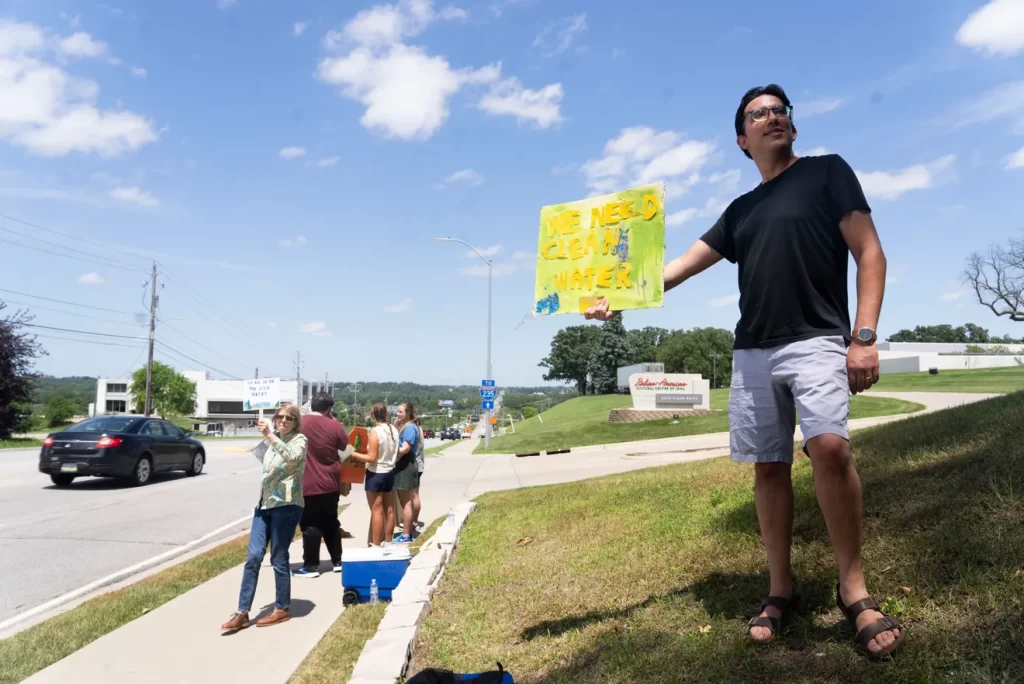
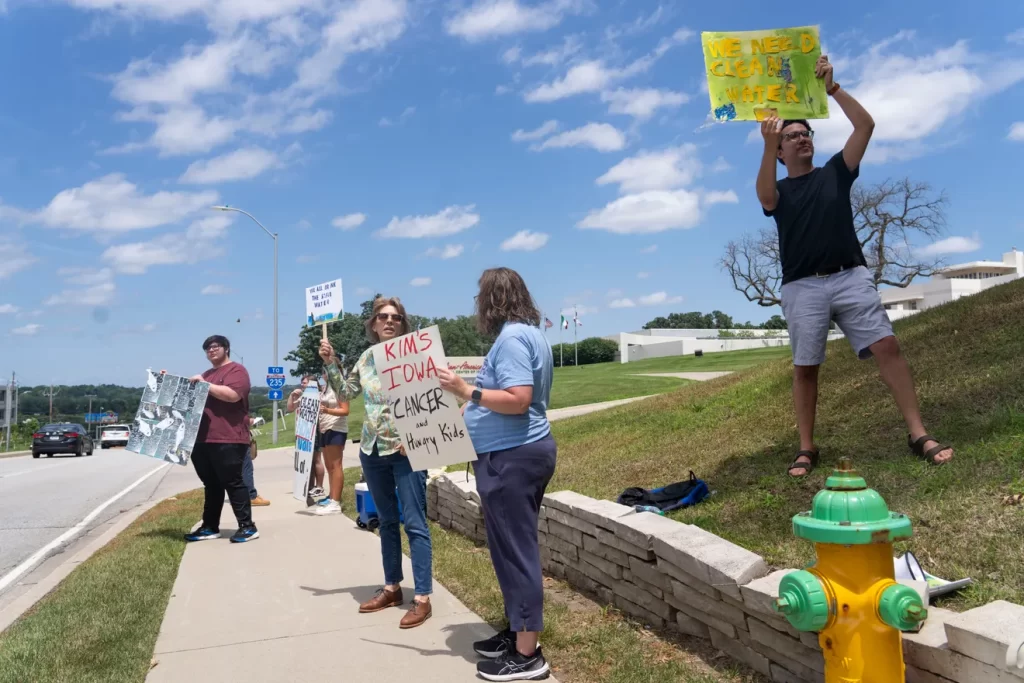
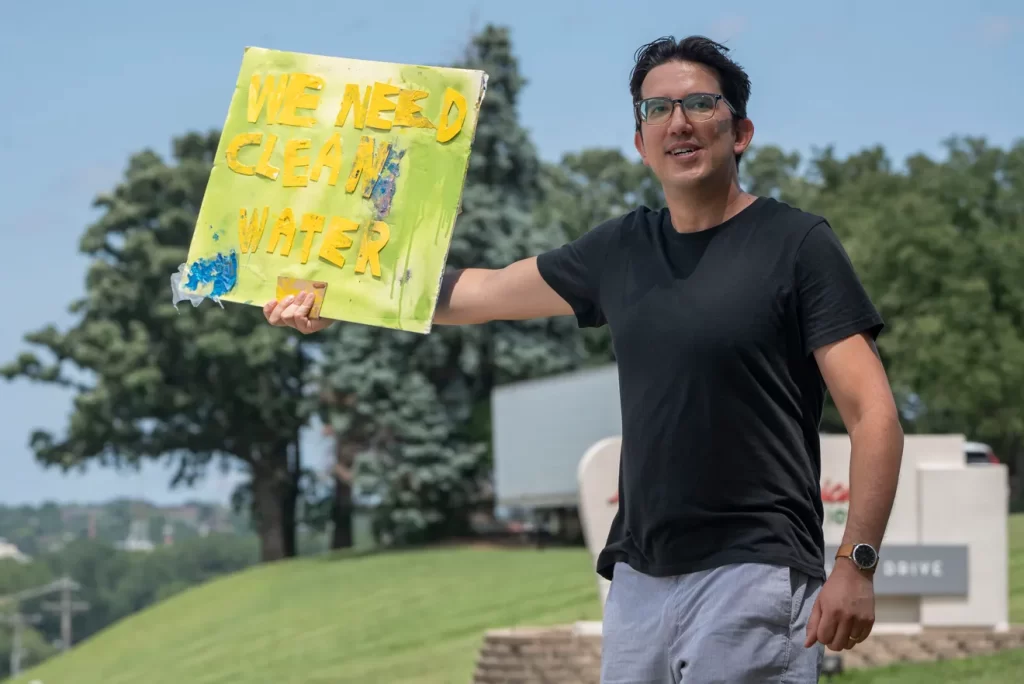
Reynolds’s comments came as nearly a dozen activists from Food & Water Watch Iowa and allied groups protested outside the event, carrying signs that said “Clean Water Now” and “We’re #1 (On Cancer and Polluted Water Sheds).”
“We have known for a long time that agriculture is the main contributor to water pollution in our state and is a very big contributor to the astronomical cancer rates in our state,” said Adam Bessman, 19, a Drake University student interning with Food & Water Watch Iowa.

Bessman said both of his grandparents and all of his great-grandparents battled — or died from — cancer in Iowa.
“This is an issue that is very personal to me,” he said. “Our leaders ignore what’s harming Iowans, ignoring their constituents’ voices to line the pockets of big agriculture, and that’s completely unacceptable.”
Iowa ranks second in the nation both for overall cancer incidence and for the fastest‐growing rate of new cancer cases, according to the 2025 Cancer in Iowa report.
Bessman noted the Polk County study found that the Des Moines and Raccoon rivers, which supply Des Moines’ drinking water, routinely exceed the 10-milligrams-per-liter limit set by the U.S. Environmental Protection Agency for safe drinking water.
The report attributed roughly 80% of those nitrates to industrial agriculture — both commercial fertilizer and concentrated animal-feeding-operation manure delivered through drainage tiles.
The report recommended the state take stronger action, including:
- Requiring farmers to report their manure applications, setting clear pollution limits and building a public map of where manure is spread;
- Tieing farm subsidies to proven conservation practices such as cover crops and bioreactors;
- Considering a tax on fertilizer to curb overuse; requiring permits and regular water‐quality monitoring at factory farms; and
- Using state and federal funds on large-scale treatment and river restoration projects.
Since June 12, Central Iowa Water Works has imposed a lawn-watering ban for its 600,000 customers because it’s nitrate-removal equipment — running at full capacity since April — risked being overwhelmed by seasonal irrigation.
Water Works officials have said the utility needs several consecutive days of Raccoon and Des Moines river readings below 10 mg/L before lifting the watering ban.
Protesters pressed the state Thursday to do more to regulate the ag industry.
“Kim Reynolds has done nothing, nothing to improve our water quality, and it’s gotten worse since she’s been governor,” said Kim Hagemann, 61, a longtime Ankeny resident and citizen-scientist with the Iowa CCI and the Izaak Walton League.
Hagemann said she and her husband spent more than $2,000 on a reverse-osmosis system for their home. “We shouldn’t have to pay that. We’re drinking high-nitrate water day after day, year after year,” she said.
Water Works has consistently said its drinking water is safe, despite the rivers’ high nitrate levels.
“Our political establishment is beholden to corporate agriculture. They’re using their massive profits to corrupt our politics,” said Michaelyn Mankel, 29, of Des Moines, an organizer for Food & Water Watch Iowa. “While leaders have sat on their hands debating this crisis, our health and our quality of life have been at stake.”
Mankel and fellow activists stood in the sun for over an hour as cars drove by, some honking in support and others in opposition.
But, Reynolds said Thursday that farmers are already adopting conservation practices voluntarily.
“It’s in their best interest to make sure that they’re doing everything that they can to protect the water and soil that they’re wanting to pass on to their next generation,” she said. “Farmers don’t want to waste inputs … There are processes right now that can tell the exact amount that each plant needs to get the growth that they need.”
She pointed to financial support under her administration.
“I think since I’ve been governor, we’ve allocated about $700 million to conservation practices. It’s been a priority since Day One. The first bill I signed into law was to provide a dedicated revenue and growing revenue source to water quality,” she said.
Reynolds said Agriculture Secretary Mike Naig recently announced a grant for the Beaver Creek watershed to help address nitrate concerns.
Reynolds also said her office is working directly with both Central Iowa Water Works and Des Moines Water Works to find solutions for nitrate runoff.
“When they pull that nitrite out, they need some place to send it,” she said, adding that the state is “trying to figure out a way that we can help move that out so they can … help the process move a little bit faster.”
Stay in the know with stories that matter — visit HolaAmericaNews.com for the latest news, culture, and community updates
Facebook Comments