

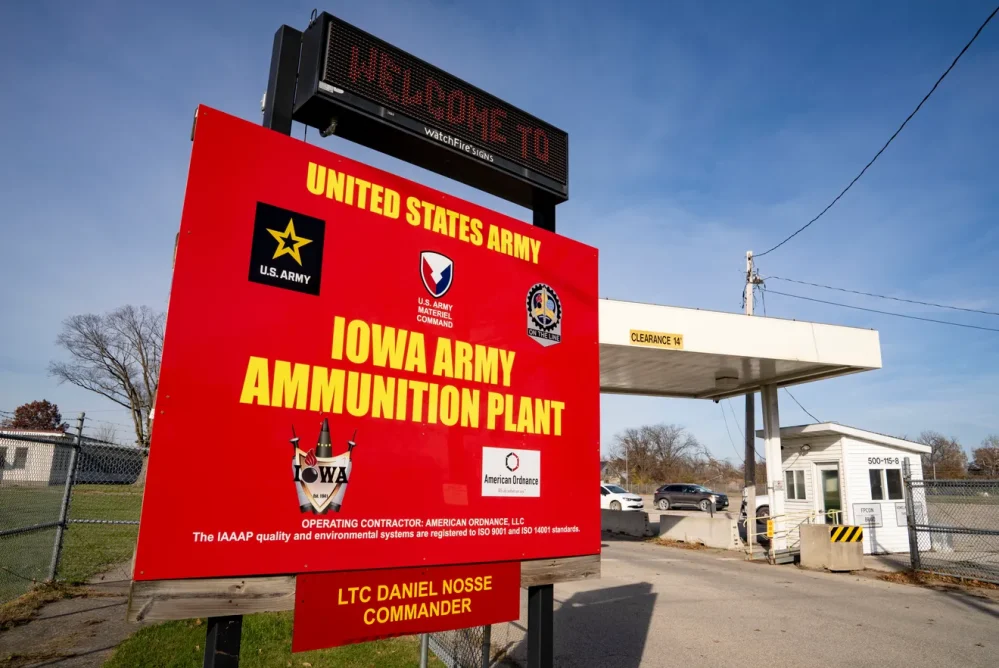



By Brian Smith, Des Moines Register
Originally updated Nov. 22, 2026. Edited for clarity by Hola America News on Nov. 23, 2026.

The U.S. Army has again delayed plans to carry out a controlled detonation of 68 barrels of lead azide at the Iowa Army Ammunition Plant in Middletown, Iowa.
The detonation was originally scheduled for Friday, Nov. 20, but was postponed until Monday, Nov. 23, after Iowa residents and public officials raised environmental and health concerns.
The Army announced Sunday night that the detonation had been rescheduled for Wednesday, Nov. 25, to allow for better weather conditions and time to put safety measures in place.
The announcement did not specify a time for the detonation or include updated maps showing how far airborne lead particles could travel.

The Iowa Environmental Council and the Sierra Club’s Iowa chapter challenged an emergency permit issued by the U.S. Environmental Protection Agency (EPA), arguing that the agency failed to complete necessary steps before authorizing the operation.
On Nov. 19, the U.S. Court of Appeals for the Eighth Circuit temporarily suspended the permit while considering the groups’ legal challenge.

In a court filing on Saturday, Nov. 21, the Justice Department said the Army intended to invoke an emergency exception that would allow it to proceed without the EPA permit.
Federal officials warned of an “immediate risk” of an accidental explosion as temperatures drop below 30 degrees Fahrenheit. According to the National Weather Service forecast cited in the original report, Monday night’s low in Middletown was expected to reach 22 degrees, with daytime highs generally in the lower 40s during the week.

The court filing said the bunkers holding the barrels had become more vulnerable to temperature changes because their blast doors were removed during preparations for the detonation and could not be replaced.
The Army said it intends to follow the planned mitigation measures regardless of whether the permit is reinstated.
More from Hola America · School notices and the Army’s original evacuation plan for Middletown
Amount of lead that could be released remains unknown
Environmental groups cited projections indicating that airborne lead particles from the detonation could travel 100 miles or more from the plant under weather conditions anticipated for the original Nov. 20 operation.
It remains unclear how Wednesday’s weather could affect the direction and distance of the plume. Updated modeling would be needed to determine which communities could face potential exposure.
Lead is a neurotoxin that can cause serious health problems, particularly for young children, pregnant women and older adults. Health risks depend on the amount and duration of exposure, and no scientifically established risk-free level of lead exposure has been identified.
Brief exposure to low concentrations of lead is not equivalent to prolonged exposure over months or years, and it does not automatically result in lead poisoning. However, even short-term exposure can present risks depending on the circumstances.
The Army previously declined to estimate how much lead could be released into the air following the detonation.
The EPA’s emergency permit requires the Army to model airborne lead dispersion to an outer concentration of 0.18 micrograms per cubic meter. That concentration defines the outer boundary used in the model for public notification purposes; it is not a reporting threshold for the amount of lead released.
For historical context, EPA monitoring data show that the national median of annual maximum three-month average lead concentrations fell from 0.53 micrograms per cubic meter in 1980 to 0.011 in 2024. These national figures describe historical air quality trends, not projected concentrations from the Middletown detonation.
Iowa agencies coordinate detonation response
Iowa Gov. Kim Reynolds launched a dedicated state information website Sunday, bringing together resources and updates from the Army, EPA and other agencies.
Reynolds said the operation remains under federal control, but state participation is necessary to coordinate preparations and help address the needs of Iowa residents.
The Iowa Department of Homeland Security and Emergency Management, Iowa Department of Health and Human Services, and Iowa Department of Natural Resources are coordinating with federal officials through the State Emergency Operations Center, which Reynolds activated Friday, Nov. 20.
State health officials are evaluating potential public health effects and working with federal and local partners on precautionary guidance.
Residents can check the Army’s current public notifications for changes to the detonation schedule and official safety information.
Stay in the know with stories that matter — visit HolaAmericaNews.com for the latest news, culture and community updates!
Facebook Comments