



By F. Amanda Tugade, Des Moines Register
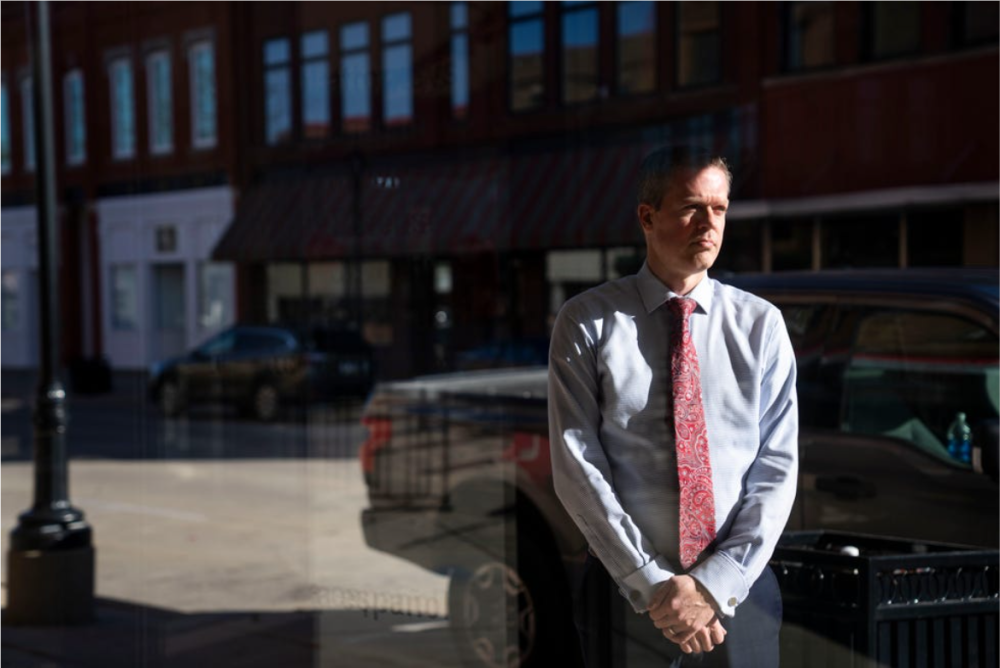
Eldora, IA — On a September afternoon, Tim Farmer climbed into his truck, plugged his laptop charger into a car USB port and logged onto a Zoom call with Escucha Mi Voz. For over an hour, while parked outside a diner, the Perry lawyer met three families and the Iowa City immigration rights group to offer free legal help and answer questions about their immigration statuses.

Like clockwork with each family, Farmer sat up, flashed a soft smile and reintroduced himself as new faces emerged onto the screen.
“Soy Tim Farmer. Soy abogado,” he said, introducing himself as a lawyer to each of them in Spanish.
Farmer spent Tuesday, Sept. 16 on the road, driving an hour and a half from his office in Perry to Eldora to meet a client being held at the Hardin County Jail after federal immigration agents arrested him during a traffic stop. The lawyer answered calls from clients and their families, including the worried girlfriend of the man in Hardin County who asked about visiting hours and depositing money into her boyfriend’s commissary account.
Long days have become normal for Farmer who, since January, has handled a surge of calls and requests for legal services because of the Trump administration’s crackdown on illegal immigration. In one of his first acts in office, President Donald Trump cancelled flights for refugees approved to come to the U.S. and ordered resettlement agencies to stop serving new arrivals, who would otherwise receive three months of help finding housing, employment and school for their children. He also declared a national emergency on the U.S.’s southern border and sought to end the humanitarian parole program for Cubans, Haitians, Nicaraguans and Venezuelans.

Farmer is among Iowa’s immigration lawyers who say they are overwhelmed by the number of people who need access to legal services. Even before the Trump administration’s moves, services were already strapped, particularly in rural areas. The need, they say, has only grown as the administration’s frequent changes to immigration policies and push for expedited deportations creates new challenges for lawyers seeking to help clients remain in the country and with their families.
From Jan. 1 to July 28, U.S. Immigration and Customs Enforcement has made 693 arrests in Iowa, according to the Deportation Data Project. The project gathered and released data showing individual case information for ICE arrests and deportations. That Iowa arrest number is more than double the 298 ICE arrests in 2024 — and more than five times the 123 reported in 2023.
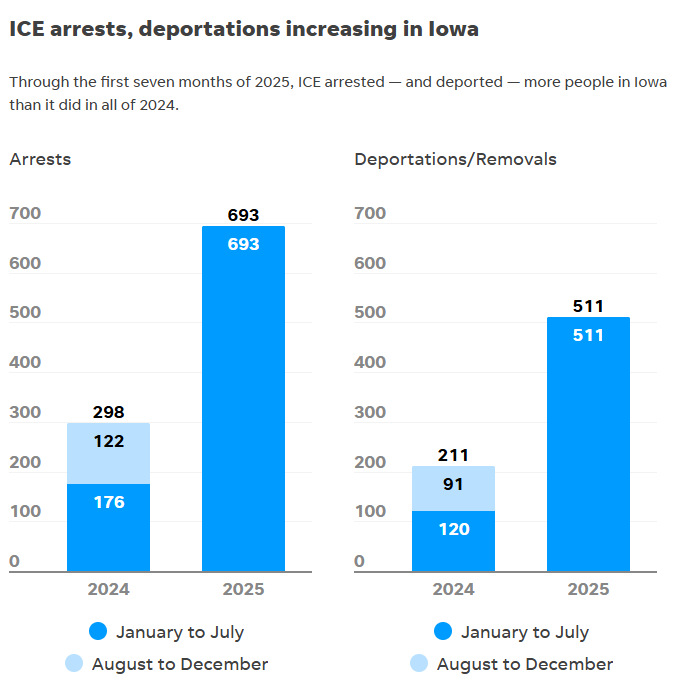
NOTE: 2025 data through July 28. “Deportations/removals” includes deportations, voluntary removals and removals due to inadmissibility.
In those seven months, 511 people in Iowa were either deported, left voluntarily or removed because they reentered the U.S. before they were authorized to, according to the data. That number was 211 in 2024.
Many people, including those in Iowa, have cheered the increase in arrests and deportations. They believe the country’s immigration system was broken long before the crackdown — and the president is finally fixing it with his aggressive moves.
Recent ads from the Department of Homeland Security tout reasons behind the administration’s push for immigration enforcement.
“America is not a nation of immigrants,” DHS Deputy Assistant Secretary Micah Bock said in a Nov. 16 video posted on social media. “We are a nation of citizens, and it is because of those citizens that we are an exceptional nation. The first duty of our government is to defend people’s well-being, way of life and safeguard our nation’s heritage.”
But the approach has had consequences, both for Iowa lawyers and for the people they work to defend.
“I worked as an immigration attorney through the first Trump administration as well and I would say that this time things are much more aggressive,” Farmer said.
“It’s not letting up anytime soon,” he added in a Nov. 7 interview.
According to the American Immigration Lawyers Association, 211 immigration attorneys are members of the national organization’s Iowa and Nebraska chapter. Of that number, about 74 are based in Iowa. While these figures are not an exact count of all Iowa attorneys practicing immigration law, they offer a glimpse of the resources available to immigrants seeking legal consultation or representation.
The list of immigration lawyers in Iowa is even smaller when taking into account specialties. Roughly one-third of American Immigration Lawyers Association Iowa lawyers handle removal proceedings, said Gunda Brost, the chapter’s media liaison and an immigration attorney in northeast Iowa. More focus on business immigration and work with companies on employment visas or filings with agencies such as the U.S. Citizenship and Immigration Services or the National Visa Center.
“People who are caught up in Trump’s enforcement — they are not even going to be able to find an employment immigration lawyer to take on their case,” she said.
Those living in rural areas have fewer options, with most immigration lawyers located in larger cities such as Des Moines and Cedar Rapids.
“If you think about who the immigrants are, a lot of them are in meat packaging plants, construction … where they are necessarily in rural areas,” Brost said. “In other words, it’s difficult for them to access.”
Brost, whose firm is in Cedar Falls, serves clients from the area and Waterloo. The next closest immigration lawyer is in a 40-mile radius or at least an hour drive, she said.
Brost said some clients have turned to nonprofits for legal help but struggled to make appointments with staff because of the high demand or limited slots.

Access to legal representation is “a life-changing protection,” reported the Transactional Records Access Clearinghouse, a Syracuse University data organization that tracks immigration detention. People who receive legal counsel are more likely to “win relief from deportation,” the group said.
Of the court cases decided nationwide from 2019 to 2024, 62% of immigrants without a lawyer were deported compared to 27% of those with one, the American Immigration Council found.
Cost and language are barriers for many, Brost said. It can be hard for clients to navigate the U.S. immigration and court system especially if their English is limited. That means access to bilingual or multilingual lawyers and quality interpreters are vital.
Of the top 10 languages spoken in immigration court, TRAC found noncitizens who speak Creole and had no legal representation were highly likely — 93% — to receive a removal order in fiscal year 2025. More than 80% of Spanish speakers also received removal orders — and over 85% were unrepresented in cases that ended in removal.
The case against one of Farmer’s more high-profile clients, Pascual Pedro, a 20-year-old who was arrested and detained after a routine ICE check-in, underscores how quickly immigration lawyers must work. Pedro, a Guatemalan immigrant who lived in West Liberty with family and worked in construction, was deported to his home country a five days after his July 1 arrest.

Farmer said he didn’t even have a chance to represent his client. An immigrant rights group hired Farmer July 3, but because of the July Fourth holiday, many offices were closed. The Monday after, as Farmer filed a stay of removal petition, he learned Pedro already was in Guatemala.
In 2018, Pedro, then 13 years old, fled to the U.S. from Guatemala with his father. U.S. Customs and Border Protection officials issued them both an expedited removal but only Pedro’s father was deported. Pedro was issued an order of supervision, which allowed him to temporarily live in the country with strict conditions while waiting final deportation orders.
“He’s basically just been living in the U.S. for the past few years at their whim,” Farmer previously said. “They can decide to execute the order of removal at any time, and that’s what they’ve done.”
Wave of policy changes bring new challenges for immigration attorneys, organizations
On the drive to Eldora, Farmer’s electric truck became a makeshift mobile office. Tangled ties took over the glove compartment, his blazers in the trunk. Ceaseless phone calls have replaced a pastime — listening to audiobooks of classic literature.
“I get interrupted so much,” said Farmer, who left a law firm in Perry after 10 years to start his own private practice in January.

He anticipated a heavier workload, but not like this.
Organizations such as Iowa Migrant Movement for Justice and Lutheran Services in Iowa have felt the brunt of a state scarce of affordable immigration legal services. Limited funding to deliver those services often lead organizations to turn clients away and refer them to private attorneys such as Farmer, said Ann Naffier, co-legal director at Iowa MMJ, and Nicholas Wuertz, who oversees LSI’s immigrant and refugee services.
“People keep asking me, ‘oh, you must be really busy?’ but the truth is I’ve always been really busy,” Naffier said. “We’re just more stressed.
“Is there much more work to do? Yes. But we were already at capacity.”
Iowa MMJ recently expanded its legal clinics to combat the Trump administration’s changes to programs, including those that revoked the temporary legal statuses of immigrants already living and working in the U.S. The organization, which provides free or low-cost legal services, began offering legal counsel clinics to help more of those individuals explore options, if any, to remain in the U.S.

Legal clinics are popular among Iowa MMJ clients, but space is limited. Some clinics with 10 appointment slots have seen 200 community members apply, said Elena Casillas-Hoffman, communications specialist.
In August, Iowa MMJ held an emergency clinic in Ottumwa for JBS meatpacking plant workers whose work visas had been revoked and who were at risk of deportation. Many of the 200 workers had temporary legal status through the CHNV parole program. That program ended in May and once protected immigrants from Cuba, Haiti, Nicaragua and Venezuela from deportation and gave them work visas. It hosted other clinics in Clarion and Storm Lake, where communities faced a similar issue and people whose legal statuses were “ripped out from underneath them” were laid off in droves, Casillas-Hoffman said.
Those kinds of policies are among the factors driving people to seek assistance from Iowa MMJ’s legal team. Heightened fear and anxiety among immigrant and refugee communities are another.
Having a larger legal team also allowed the advocacy organization to see more people. Iowa MMJ has four attorneys — one of whom was added last year and focuses on detained community members — and six representatives accredited by the Department of Justice to provide immigration legal services. Two bilingual administrative assistants and two legal workers also joined the team this year.
Iowa MMJ is one of 10 organizations in the state — and one of three in Des Moines — recognized by the Department of Justice and has accredited representatives authorized to represent clients with immigration cases, including family petitions and work visa renewals.

Two LSI staff members are taking courses to become federally accredited representatives — a start to the nonprofit’s longtime goal of having its own immigration legal services branch.
The changes to immigration policies under the Trump administration add fuel to that goal, Wuertz said.
Recent changes to SNAP benefits are affecting LSI refugee clients, who are no longer eligible for the federal program under HR 1, also known as Trump’s “One Big Beautiful Bill Act.” People granted asylum, survivors of domestic violence and human trafficking and other noncitizens also are unable to get assistance under the bill, which became law in July.
“With the passage of the bill, it restricts their access to programs until they gain lawful permanent residency or green cards,” which they can apply for after a year, Wuertz said.
Refugees also can apply for citizenship after five years. Both those steps would require assistance of immigration legal services.
“It just increases the urgency for access to affordable immigration legal services so that refugees and other humanitarian immigrants can timely get their green card and once again be eligible for some of those safety next programs,” Wuertz said.
‘It’s a blessing’ if detained migrants get out of jail, lawyer says

At Hardin County Jail, Farmer walked past the secured doors and into small white room with a single chair and a glass window and waited for his client to enter.
A detail in the man’s case speaks to a new trend Farmer has noticed: Traffic stops turning into immigration arrests are more common as the Trump administration ramps up immigration enforcement. The man was stopped in Wright County for using his cell phone while driving, which consequently led to his arrest by federal immigration authorities.
“Sometimes, people get stopped just for having a headlight out or something like that and then the officer finds out they don’t have a license,” Farmer said. “Sometimes, they’ll even be arrested for driving without a license, which is not normally something that you would be arrested for.
“Some officers will arrest you for driving without a license if they find out the reason you don’t have a license is because you’re undocumented.”
And if you’re an undocumented immigrant, you may not be eligible for bail.

An ICE policy change prevents judges from granting bond to most detained migrants, which Farmer and Des Moines immigration attorney Alexander Cárdenas Cruz said further limits their clients’ legal options.
“If you get out of jail, it’s a blessing honestly,” said Cruz, who works at the downtown Des Moines law firm Mueller Schmidt Mulholland & Cooling.
Cruz said voluntary departure, an alternative to deportation, has become more appealing to his clients who have been released from ICE custody or are in detention.
“A lot of people are taking it,” he said. “They have been in jail for a couple of weeks, and they’re just sick of being in jail — which I don’t blame them — because they’re not hard criminals.”
Hardin County Jail is one of six Iowa county jails contracted by the U.S. Marshals Service to hold federal inmates. Polk County Jail — the largest of the six that also includes Linn, Muscatine, Pottawattamie and Woodbury counties — has 170 to 200 beds reserved for federal inmates, said Lt. Mark Chance, spokesperson for the Polk County Sheriff’s Office.
Sixty-four of those beds are for ICE.
To be granted voluntary departure, individuals must admit to being in the U.S. without immigration documents and withdraw submitted applications or petitions. Those who leave voluntarily could trigger a 10-year ban from reentering the U.S. and pay penalty fees up to about $10,000.
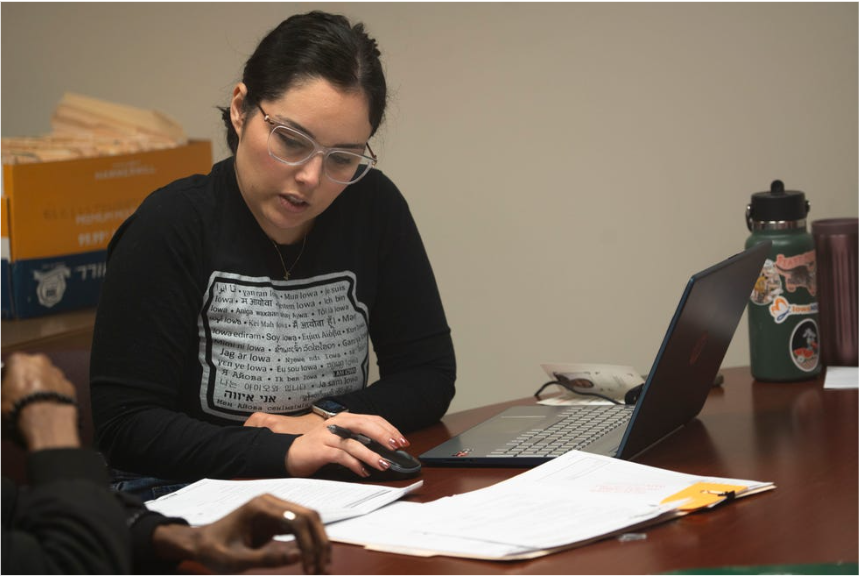
Like Farmer, Cruz said he continues to field more requests for legal services since Trump stepped into the Oval Office in January.
The work has been nonstop.
“We’ve been talking for 20 minutes, and I have five missed calls from people, either clients or (those) looking for representation,” Cruz said during a Nov. 6 interview.
“Every time now that somebody on Instagram says that something’s happening, I get a call,” he said. News of ICE arrests across the country, including Iowa, frequent changes to immigration laws or new fees tacked on to immigration applications cause his phone to ring.
“If there’s a news article that comes out that says that somebody got deported at a court hearing, I get a call (from a client asking,) ‘Am I going to get deported at my court hearing?'” he said.
In October, calls poured in as people learned of a new policy that would require them to pay $100 each year their asylum applications are pending. A federal judge temporarily blocked that change that same month after the Asylum Seeker Advocacy Project filed a lawsuit against USCIS over the fee.

The uncertainty is hard to face. So are the tears from Cruz’s clients.
Families are scared to be separated — to lose loved ones with no possible return date in sight. Cruz said he has the tough job of telling people they may not win their cases.
With clients facing deportations, he speaks with families about their next steps, which could entail plans on what they could do to legally return to the U.S.
“I’ve always, at least, made sure to really enjoy the wins,” he said. “Because that’s how I can tell myself I am making a difference.”
“But I can tell you every client that I’ve lost and their names and how we lost and how their families dealt with it because I’ll never forget that,” Cruz said. “Those are the hardest conversations I’ve ever had in my life.”
Stay in the know with stories that matter — visit HolaAmericaNews.com for the latest news, culture, and community updates!
Facebook Comments