




Superintendent of Iowa’s largest school district has become a political lightning rod
With an alleged weapons charge, a firearm citation and a loaded gun reportedly found in his vehicle, any immigrant arrested after a judge ordered him deported would have an extremely difficult, if not impossible, chance of remaining in the U.S. — regardless of who is president, immigration advocacy organizations say.
That Des Moines Public School Superintendent Ian Andre Roberts may also have lied to Des Moines Public Schools — indicating on his job application that he was a U.S. citizen when federal officials have alleged he wasn’t — does not improve his case.

In an exclusive interview Sept. 28 with Reader’s Watchdog, Alfredo Parrish, a prominent Des Moines attorney whose firm is assisting Roberts and his family, said: “I don’t think anyone is shying away from the fact that this is a serious matter, not only to Dr. Roberts but the entire community. When we decide what route we’re going to take, we want to have credibility and be as transparent as we can be.”
But Parrish also noted Roberts has been a “great source of inspiration to this community in the way he has brought light to the educational system. … And he has been an inspiration to so many students and people, especially minorities. That’s a big factor in a state like Iowa. We want to give him big credit for that.”
Des Moines School Board Chair Jackie Norris, a Democratic U.S. Senate candidate under attack by some Republican lawmakers since Roberts’ arrest, warned there is still much about Roberts’ dramatic immigration case to be learned.
But she emphasized to the public on Sept. 27 that Roberts affirmed to the district he was a U.S. citizen who was eligible to work in the district when he was hired in 2023.

“The accusations that ICE has made against Dr. Roberts are serious, and we are taking them very seriously,” Norris said when Roberts was placed on paid leave.
The weapons charges against Roberts, leveled by the Department of Homeland Security, matter greatly because the federal Gun Control Act makes it unlawful for “illegal aliens” to ship, transport, receive or possess firearms or ammunition.
Roberts’ massive challenge in the days ahead likely will be to find a new way to reopen his immigration case — something a federal judge denied in April — or to have his May 2024 removal order cancelled before he is deported.

Parrish said when he’d spoken to Roberts on Sunday, Sept. 28, his spirits were good and Roberts appreciates all the support he has received. The prominent Des Moines lawyer said the calls to his firm from around the country expressing support have been incredible.
He said five or six attorneys at his office have been reviewing the Guyana native and former Olympian’s legal and professional history in the United States. An educator for more than two decades, Roberts has led Iowa’s largest school district since July 2023.
But a removal order is generally final after a 90-day appeal period. And the loaded weapon DHS officials say agents found in Roberts’ vehicle when they arrested him make his case even more grave.
U.S. Rep. Zach Nunn is among many state and local leaders who have sought to clarify Roberts’ immigration case history.
On Sept. 27, Nunn announced he made a federal open records request for source documents to DHS and Immigration and Customs Enforcement to clarify their actions and give the public transparency, noting the case had raised questions about how someone in the country illegally could have gained such a position of public trust.
Nunn said he strongly supported ICE’s efforts to identify and remove “illegal aliens” who pose a threat to public safety.
“At the same time, it is important to our community to establish a clear, verifiable timeline and confirm that ICE’s enforcement actions involving a senior public official were supported by proper documentation,” he wrote in a letter to Homeland Security Secretary Kristi Noem and ICE Acting Director Todd Lyons.

Zach Boyden-Holmes/The Register
Immigration removal orders are often final
Applications for lawful permanent resident status, or green cards, are usually handled by U.S. Citizenship and Immigration Services, or USCIS, and must be decided by an immigration judge for those going through the removal process.
Those judges can issue waivers for certain types of conduct that might be obstacles, according to the American Immigration Council, a national nonprofit that does advocacy work.
Noncitizens can attempt to reopen a closed immigration case after a removal order with the Board of Immigration Appeals, or an immigration court, presenting new evidence or a significant change in circumstances.
But the general deadline is 90 days from the final removal order, according to the Immigrant Legal Resource Center, another nonprofit organization.

Lily Smith/The Register
In April 2025, an immigration judge in Dallas, decided not to reopen Roberts’ immigration case in absentia, Fox News and other media have reported.
In rare cases, ICE can grant a “stay of removal,” often for humanitarian reasons. In other cases, individuals are provided with “deferred action,” a form of executive clemency that allows people to temporarily remain in the United States and work here.
Several attorneys in Des Moines, with whom the Reader’s Watchdog spoke Sept. 27 and 28, declined to comment publicly, for fear of their clients becoming federal targets. But they said the only ways now Roberts may be able to reopen his case after being ordered to leave the country is to assert ineffective assistance of prior counsel or a failure by the government to provide proper notice when the Dallas judge opted not to reopen his case in absentia.
Parrish said those lawyers are correct. “Those are two ways to reopen it,” he said. “To say there are no other ways to reopen — we are still doing our due diligence.”
To reopen an immigration case after a judge’s in absentia order, there must be evidence and a clear explanation demonstrating the failure to appear was the result of not receiving proper notice.
Getting an immigration judge to cancel a final removal order can and does happen in the U.S., but it is uncommon.
Some removal proceedings are initiated based on criminal convictions that are nonviolent or otherwise minor. If a judge determines that a particular individual has a prior conviction for an “aggravated felony,” regardless of how serious or minor the conviction was, that person may be barred from many forms of relief from removal, according to the American Immigration Council.
A noncitizen with a criminal conviction is entitled to a hearing before an immigration judge to determine if that conviction has immigration consequences. Federal immigration law is constantly evolving regarding whether a particular criminal offense makes someone removable from the country or precludes them from being granted immigration relief, the council said.
The council also has noted that noncitizens with lawful status can be removed from the country for many reasons, even minor criminal convictions or false claims of U.S. citizenship.
Another challenge: Superintendent Ian Roberts has become a political lightning rod
The Department of Homeland Security has said Roberts, a known hunter, abandoned his car and fled law enforcement on the morning of Friday, Sept. 26.
The agency said he was in possession of a loaded handgun, $3,000 cash and a hunting knife. He was arrested in what DHS described as a “targeted enforcement operation.”
DHS has since accused the 54-year-old longtime educator of violating federal law by

possessing a handgun while in the U.S. without legal authorization and said it was referring him to the Bureau of Alcohol, Tobacco, Firearms and Explosives for further investigation.
Roberts, who was being held in the Woodbury County Jail over the weekend, has become a national lightning rod for both the political right and left since he was apprehended.
His supporters have called him a high-profile political target of an overzealous and racist administration, while ICE officials and critics on the right have called him a threat to public safety and danger to Des Moines families.
His arrest prompted leaders in Iowa’s Republican-controlled state Legislature to call hearings of their oversight committee, urge Des Moines School Board members to resign, and pledge to bolster background checks on Iowa educators.
But Roberts’ supporters have gathered by the hundreds, touted his benefit to the community and urged his immediate release. Many, like Hoover High School Principal Qynne Kelly, urged Des Moines residents to consider the seasoned educator’s track record.
“They desperately want to paint this man as a criminal,” Kelly said in a Facebook post. “Unfortunately for them, Dr. R is a sup for the people. He is highly visible in all public spaces; so many, many people know & trust him. We believe in his vision.”

Ian Roberts was born in Guyana, ran in the 2000 Olympics
Some Iowans have questioned whether Roberts’ case had just been discretely moving through immigration court or whether his arrest was politically motivated.
“That’s a good question,” Parrish said. “We don’t have a sense of that yet. All we’re doing is going through the files.”
Federal records and previous reporting show Roberts was born in Guyana, a country of around 831,000 on South America’s north Atlantic coast, and grew up in Brooklyn, New York.
Before his career in education, he competed in the 2000 Sydney Olympic Games for Guyana as a mid-distance runner.

A statement from DHS said he entered the United States on a student visa on a F-1 student visa at St. John’s University in 1999.
Questions remain about gun charges against Ian Roberts
The Department of Homeland Security has said Roberts had “existing weapon possession charges” from Feb. 5, 2020. If true, Roberts’ current immigration problems likely began under the administration of President Donald Trump’s first term. The removal and deportation order last year came under the presidency of Joe Biden.
The Dallas immigration judge’s refusal to reopen his case came this year came shortly after Trump’s second term began.
ICE’s communications arm told the Des Moines Register in an email Sept. 26 that Roberts was arrested on the weapons charge by port authority police in February 2020. But the agency hasn’t responded to questions asking for additional details about the alleged crime.
There are multiple local port authorities across the country, and it is not clear which one would have made the alleged 2020 arrest.
DMPS Spokesman Phil Roeder said the district has no information on a weapons charge from 2020.
Parrish said his firm is also looking into that allegation.
“I think it would be premature to make an assessment that it was a charge,” he said. “At this point, that can’t be verified.”
In an apparently unrelated incident, Roberts was given a citation and fined $100 by the Pennsylvania Game Commission for having a loaded rifle in his vehicle while hunting in November 2021, while he was superintendent of the Millcreek School District.
At the time, he told the Erie Times News he was aware that loaded firearms were not permitted in vehicles and he had planned to unload it before leaving. But he put the rifle in his vehicle “to ensure the warden … did not feel unsafe or threatened in any way” while they talked.
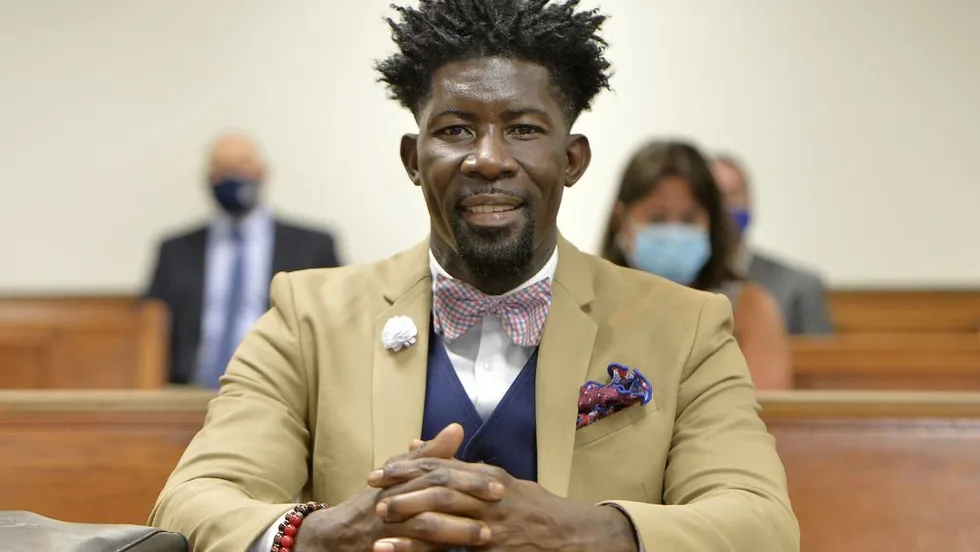
Roberts disclosed the 2021 conviction during his Des Moines hiring process, Roeder said.
Parrish said there might have been “a certain date” where Roberts was allowed to come into the country legally and a legitimate argument for him being able to have a firearm.
That is what, he said, his firm is still reviewing.
“We’re trying to find out what circumstances exist with regard to his status. We don’t know yet. We’re still going through the documents,” he said. “I will tell you we have contested in the past whether a person who is a noncitizen can have a firearm. I always say in court, the exception is really what makes a rule a rule.”
Stay in the know with stories that matter — visit HolaAmericaNews.com for the latest news, culture, and community updates!
Facebook Comments